

Stop looking for the average sub. There is not one, because clubs sell two different products. Across 41 UK clubs whose published fees we could read and classify, an all-in season sub had a median of £160, and a club charging per session took a median £30 a year plus £3.50 to £12 a night. Only one split-model club asks more than £70, and no all-in club asks less than £105. Decide which model you are running, then build the number from your own court hire, which is what actually drives it.
Get it wrong and it shows up in March: the hall invoice is paid, the shuttle order is not, and somebody has to stand up at the AGM and explain why.
The short version
- Two products, not one price line. All-in season sub, or a small admin sub plus pay-per-session. The gap between them is real and almost empty.
- Court hire is the driver. National affiliation is around a tenth of a typical sub, and clubs consistently over-weight it.
- Shuttles are the line people forget. A feather-playing club can spend more on them than on all its affiliation put together.
- If you are a CASC, there is a threshold you have probably never heard of. Above £520 a year in total costs to a member, you must make advertised provision for people who cannot pay more.
- The guest fee's job is conversion, not revenue. Median £8, and two or three visits before deciding is the usual arrangement.
- Check whether you are short of members or short of courts. If you are turning people away, price is a rationing tool and most of this advice inverts.
Written for a UK club treasurer or committee setting next season's price. Fees come from probing 923 UK club websites on 26 August 2026 and reading by hand every page that stated a price. Forty-one were a club publishing its own fees clearly enough to classify. Not tax advice.
In this guide
What do UK clubs actually charge? Which model are you running? What does the sub have to cover? How do you work the number out? What if attendance drops? Short of members, or short of courts? What should a guest session cost? How deep should concessions go? Should the club hold a surplus? If you are a CASC, is there a ceiling? How do you put subs up? Should you publish the price at all? Frequently asked questionsWhat do UK clubs actually charge?
Two clearly separate things, and quoting a single average across both is the mistake every other page on this subject makes.
We probed the websites of 923 UK badminton clubs and read every page that stated a price. Forty-one turned out to be a club publishing its own fees clearly enough to classify. Twenty-one charge an all-in season sub with sessions included. Fourteen charge a small annual sub plus a fee every time you play. Six charge no membership at all and take money at the door.
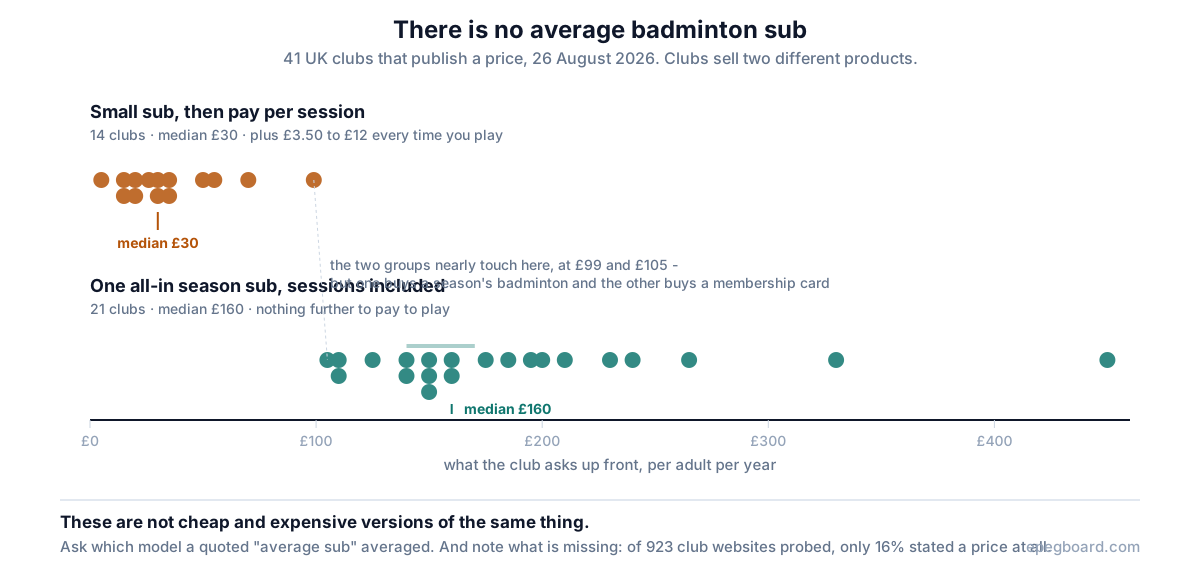
The all-in model ran from £105 to £450, with a median of £160 and half of clubs between £140 and £210. Twelve of the twenty-one sat inside that £140 to £210 band, which is a tighter cluster than we expected.
The pay-per-session model ran a sub of £5 to £99, median £30, with sessions at £3.50 to £7. The sub in that model is doing a different job: it buys affiliation and membership rights rather than court time.
So if you have been told the average badminton sub is some figure or other, ask which model it averaged. One page we found quotes thirty to sixty pounds a month for a badminton club, which is roughly three times the median all-in sub we found, and is what happens when you average two different products together.
Which model are you running?
It is less of a free choice than it looks, because the model follows from how many courts you have and how evenly your members turn up.
The all-in sub works when attendance is predictable and the courts are close to full. Everyone pays for the season, the treasurer has one transaction per member per year, and the club can commit to its hall booking knowing the money is in.
Pay-per-session works when attendance is uneven, or when the club wants to be easy to join. The people who play weekly pay more than the people who play monthly, which is fairer to the occasional player and much less predictable for the club.
The question underneath is what your attendance distribution looks like, and most clubs have never looked. If two thirds of your members play nearly every week, an all-in sub is simpler and costs them nothing. If your attendance is a long tail of occasional players, an all-in sub is quietly charging them for court time they never use, and some of them will leave over it.
What does the sub have to cover?
Write the whole list down before you pick a number, because the line clubs forget is shuttles.
- Court or hall hire - the largest line by a distance, and the one worth negotiating.
- Shuttles - for a feather club this can exceed everything else on this list except the hall.
- Club affiliation to Badminton England: £90 for 1 to 20 members, £125 for 21 to 49, £150 for 50 or more.
- Individual membership for those who need it, which is what actually carries players' insurance.
- County affiliation, which may be added during membership purchase.
- League entry fees and any match fees you do not collect separately.
- Coaching, if the club provides any.
- Equipment - posts, nets, a first-aid kit, replacement of all three.
- Socials, which are usually self-funding but rarely quite.
The arithmetic is worth doing once, because it changes where you look. Affiliation at £150 across fifty members is £3 a head, against a median sub near £198. That is about a tenth. Court hire is the number that moves the sub, and if you want the sub lower, that is where the work is rather than in the membership fee.
Worked example: 40 members, 4 courts, 2 hours, 38 weeks
Using the median court rate from our court-hire survey, £13.45 an hour.
- Hall: 4 courts × 2 hours × £13.45 × 38 weeks = £4,088.80
- Shuttles: say 4 tubes a week at £26 = £3,952 a season. If that number surprises you, that is the point of this section.
- Club affiliation (21 to 49 members): £125
- Equipment, insurance excess, socials, contingency: say £500
- Total: £8,665.80. Across 40 members that is £216.65 each.
Which lands just above the survey's upper quartile, and tells you two things immediately: this club is at the dear end, and the two levers that matter are the hall and the shuttles. Halving the shuttle line by playing nylon on two of the four courts takes roughly £50 off every member's sub.
How do you work the number out?
Total your costs, divide by the number of members you are confident of, and then check the answer against what clubs actually charge rather than starting there.
The order matters. Starting from another club's number and working backwards tells you nothing about whether you can afford your own hall. Starting from your costs gives you a figure you can defend at an AGM, line by line, which is a different conversation from "it seemed about right".
Two refinements once you have the raw number. Decide whether match fees, socials and shuttles sit inside the sub or outside it, because clubs do both and members care more about surprises than about totals. And decide what happens to somebody joining in February, because pro-rata is normal and several clubs publish a month-by-month table for it.
What if attendance drops?
A sub priced on 40 members breaks at 30, so work out the number at which it breaks before you set it.
Take the total from the worked example above and divide it by a smaller membership. At 40 members it is £216.65 each. At 30 it is £288.86. At 25 it is £346.63 and you have a crisis, because that is a 60% increase on a number people have already agreed to.
That is the margin-of-safety calculation, and it is the difference between a treasurer and a spreadsheet. The usual answers are to hold a reserve, to keep the hall booking flexible, or to price with a few members' headroom built in. What you should not do is price at exactly break-even on this year's headcount and hope.
Short of members, or short of courts?
If you are turning people away, price stops being a recruitment tool and becomes a rationing one, and most of the advice above inverts.
This is worth checking before you read any further, because it is a different situation and almost nothing written about club subs acknowledges it exists. Our survey cannot tell you how common it is, because a club at capacity has no reason to publish anything, which is itself part of the answer.
For an oversubscribed club, a low sub is not generous, it is a queue. Raising the price is one of the few levers that reduces demand without anyone having to decide who is turned away, and the money can go into a second night, which is the actual fix.
For everyone else, the reverse holds and the guest fee below matters more than the sub does.
What should a guest session cost?
Somewhere around £8, and its job is conversion rather than revenue.
Guest fees in our survey ran from £5 to £12 with a median of £8. The usual arrangement is that a visitor can come two or three times before deciding whether to join, and several clubs published exactly that.
Two things worth copying. Several clubs credit the trial fees against the membership if the visitor joins, which costs the club nothing and removes the feeling of having paid twice. And a free first session, which a handful of clubs offer, is the cheapest recruitment any club has available.
The number that matters is the relationship between the guest fee and what a member effectively pays per session. If a member's sub works out at £5 a night and a guest pays £12, you are telling visitors that joining is worth it, which is fine. If a guest pays £6 and a member effectively pays £5.50, you have removed the reason to join.
How deep should concessions go?
Deeper than most clubs go, or not at all - because a five per cent discount is worse than none.
Take the junior rate as the measurable case, since it is the concession clubs publish most. Among the clubs that stated both an adult and a junior figure, the discount ran from 50% off down to 9% off. That bottom end is the one worth arguing with: £145 against £160 does not make the club affordable to anyone who could not afford £160, and it costs the club £15 a head. One club in the survey charges its top junior section MORE than its adults.
Adult concessions are a different story, and the honest answer is that we cannot characterise them: too few clubs publish a student, over-60 or unwaged rate for any range we gave you to mean anything. The unwaged rate is the one worth thinking about even so. A student discount helps people who will earn later; an unwaged rate helps people who cannot pay now, and almost nobody offers one.
Should the club hold a surplus?
Yes, and we cannot tell you how much, because no UK benchmark for sports-club reserves appears to exist.
We looked. Sport England's club-support material says fees should cover costs and stops there. Nobody publishes a target, a percentage or a rule of thumb that traces to anything.
So use a method rather than a number: hold enough to cover a stated number of months of hall hire. Three months of your largest fixed cost is a reserve you can explain, defend and test against the attendance-drop arithmetic above. A percentage of turnover sounds more precise and means less.
If you are a CASC, is there a ceiling?
Yes, and it is £520 a year in total costs to a member, which is lower than it sounds and catches clubs that have never heard of it.
Registered Community Amateur Sports Clubs have two thresholds. A membership fee above £1,612 a year means the club is not open to the whole community and is ineligible. And where total membership and participation costs come to £520 a year or less, the club is automatically treated as open. Above £520, the club must make advertised provision for people who cannot pay more than that.
The trap is the word "total". It is not the sub. It is the sub plus match fees plus shuttles plus league entry plus anything else a member must pay to take part. No club in our survey has a sub anywhere near £1,612, and only two are above £265 a year before those extras, and a competitive player at a mid-priced club can cross £520 without anyone noticing.
If you are a CASC, add up what a fully participating member actually pays across a season. If it is over £520, you need the advertised provision, and having it is straightforward. Not knowing you need it is the problem.
How do you put subs up?
With more notice than you think, through whatever your constitution says, and we are going to be honest that the evidence here is thin.
There is no research we could find on raising sports club subs without losing members. What exists is assertion. So rather than tell you how members will react, here is what clubs actually do structurally, which is checkable:
- Set fees at a fixed point in the year. One club's rules put it at the first committee meeting after the AGM, which gives everybody a known date.
- Publish a pro-rata table so a mid-season joiner is not paying a full year for four months.
- Offer instalments at the same total. One club offers £185 in one payment or £35 plus five payments of £30, which is the same money in a shape more people can manage.
What we would add, as judgement rather than evidence: an increase that arrives with the reason attached lands better than one that arrives alone. "The hall went up 6.7% in April" is a sentence members can check and most will accept.
Should you publish the price at all?
Yes, and a surprising number of clubs do not.
We can put a number on this, because we went looking. Of 923 UK club websites we probed for a fee page, only 16% stated a price anywhere we could find, and only 4% stated one clearly enough to read and classify. Whatever else is true about club subs, the great majority of clubs are not telling anyone what theirs is.
For a club that is full, that is a reasonable choice. For a club that wants members, an unpublished price is a barrier at exactly the moment somebody is deciding whether to send the email. The people most deterred by it are the ones least confident about asking.
And the concession this guide owes you. If your sub is inside the band for your model, your concessions are real, and your courts are full, then your subs are not your problem and this article has nothing else for you. The clubs that need this arithmetic are the ones where the number was set years ago by somebody who has since left, and nobody has re-derived it since.
If you only do one thing
Add up what a fully participating member pays across a whole season, including match fees and shuttles. That is the number that matters, and it is the one nobody has written down.
Fair games, without the admin
ePegboard does not collect your subs and has no view on what you charge. What it does hold is the thing this article keeps asking about and most clubs cannot answer: who actually turns up, and how often. If you are choosing between an all-in sub and pay-per-session, that distribution is the input. Free for clubs.
Frequently asked questions
Can we charge different amounts on different nights?
Yes, and clubs do it where the nights differ in cost or demand. The complication is administrative rather than principled: two prices means two things to explain, two things to collect and two things to get wrong. Most clubs that try it end up folding it back into one rate.
Should juniors pay a share of the adult sub, or a separate rate?
A separate rate, almost always, because junior sessions usually have their own court cost and their own coaching. Working out the junior number the same way you worked out the adult one is more defensible than picking a percentage of it.
What if two clubs share a hall - can we share the affiliation too?
No. Affiliation is per club, and its insurance cover follows the club that holds it. Sharing a venue does not make you one club, and a shared arrangement that assumes it will leave one of you uncovered.
Do we have to charge the same as the club down the road?
No, and the survey suggests nobody does. Clubs a few miles apart run different models entirely. What you are competing on is the night, not the price, and members who leave over a ten-pound difference were usually leaving anyway.
Is a joining fee a good idea?
It is rare in badminton and we found none in the survey. It suppresses exactly the thing most clubs want, which is people trying it. If you need to raise more, raising the sub is simpler and reads better.
How far ahead should we announce an increase?
Far enough that nobody finds out when they are asked to pay it. Check your own constitution first: several clubs we read set fees by committee at a fixed point in the year, which fixes the notice period for you.
Where to go next
Setting the number is half of it. Collecting club subs deals with the other half, and its finding is that the payment method matters far less than how often you bill.
The largest line in the arithmetic above is the hall, and it has more give in it than most clubs realise: what UK clubs pay for court hire covers the survey and the levers. The second largest is shuttles, and feather vs nylon works out the cost per session.
If you are setting subs because you are starting from scratch, how to start a badminton club covers the rest of it.
How this guide was put together
ePegboard builds club-night software. We do not collect subs, we are not accountants, and we have never set a club's fees. The figures here come from our own survey: we probed 923 UK club websites on 26 August 2026, read by hand every page that stated a price, and verified 41 as a badminton club publishing its own fees. Alongside that sit Badminton England's affiliation prices and the government's published CASC guidance.
Three honest limits. The 41 clubs are those that published a readable price, not a random sample of clubs - clubs that publish tend to be the ones recruiting, and a club at capacity has no reason to say anything. The set is England-heavy, with a few Welsh and Scottish clubs and none from Northern Ireland. We found no UK benchmark for club reserves, so that section gives a method rather than a figure. And we found no evidence at all on how members react to an increase, so we have described what clubs do structurally and left their reactions alone. Individual Badminton England membership is quoted at more than one price depending on route, and we could not establish which applies to an ordinary club member, so no figure for it appears above.
Sources: Badminton England club affiliation · HMRC, Community Amateur Sports Clubs detailed guidance · Buddle on membership options · Hertfordshire Badminton Association fee breakdown
Published 26 August 2026 by ePegboard. Club fees read 26 August 2026; most clubs reset in August or September.