

Convert every quote to a price per hour before you compare it, then check the off-peak rate before you negotiate anything. Across the 18 UK venues we surveyed that sell a comparable court, the median was £13.45 an hour and half sat between £12.00 and £15.00. But one centre advertising £11.60 is the fourth cheapest on paper and the fourth dearest in reality, because it sells 45 minutes. And where off-peak prices are published they run 14 to 34 per cent below peak, which beats every club discount in our survey and requires no conversation at all.
Get this wrong and you find out in August: the renewal lands, it is up again, and the committee starts talking about putting subs up rather than asking why nobody read the council's fees paper in February.
The short version
- The headline rate is the least comparable number you have. Slot lengths run from 45 to 60 minutes, and some centres charge per player rather than per court.
- Check off-peak first. Where it is published it runs 14 to 34 per cent below peak. It is the largest discount in our survey and the only one you do not have to ask for.
- Ten sessions is the number that matters twice. It is the threshold for HMRC's block-booking VAT exemption and, at some centres, for a commercial discount.
- Ask whether the hall is a sports facility or a bare hall. A village, church or school hall let bare is VAT-exempt already. Asking them to put the posts and nets out can change that.
- Whole-hall hire only ever beats taking every court. At two venues the hall costs less than all five of its courts and at two more it costs exactly the same. Take one court fewer and the hall is dearer everywhere we looked.
- The club rate is real and mostly unpublished. Where centres publish one it runs 16 to 25 per cent below casual. Most say "contact us", which is the point.
Written for UK club organisers hiring courts from a leisure centre, school or university. Figures come from a survey of 24 venues whose published prices we read on 26 August 2026; 18 sell a comparable per-court unit. Seventeen of those are on 2026/27 prices and one on 2025/26, which is flagged where it matters. The VAT section follows HMRC's published guidance and is not tax advice.
In this guide
What are you actually buying? What should you expect to pay? What drives the difference? Is off-peak cheaper, and can your club use it? Does block booking get you a discount? Is VAT charged on court hire? What else is negotiable besides the rate? Is the whole hall cheaper than the courts inside it? Who do you talk to, and when? Is the venue bound by a community use agreement? Which contract terms matter as much as the rate? What do you need ready before you ask? When should you walk away? Frequently asked questionsWhat are you actually buying?
You are buying a court for a slot that is not always an hour, sometimes priced per player rather than per court, and not always including everyone who walks on with you.
Slot length is not standard. Castle Leisure Centre in Bury sells a 45-minute court and Halton Borough Council sells 55 minutes. Every other comparable venue in our survey sells a full hour. Nobody labels the short slot as anything, and it moves the real price by up to a third.
Some centres charge per player. The PEAK in Stirling prices badminton at £6.50 per adult with a minimum of two players, which for a club running doubles is roughly £26 a court-hour against a £13.45 median. A club that budgets per court and books a per-player venue has doubled its cost before anyone picks up a racket.
And "a court" does not always mean four people on it. Better's Brook Leisure Centre in Belfast states that the initial booking covers one player and reserves the court, with additional players paying separately at reception. Bury charges a guest fee of half the court fee for non-member additional players.
What should you expect to pay?
Expect a median of £13.45 per court per hour, with half the venues we surveyed sitting between £12.00 and £15.00.
No published national figure for badminton court hire exists, so we made one. On 26 August 2026 we read the published rate cards and booking pages of 24 UK venues across councils, leisure trusts, universities, schools and one independent school's sports centre. Eighteen sell a comparable per-court unit; the other six sell something else, which is a finding in its own right.
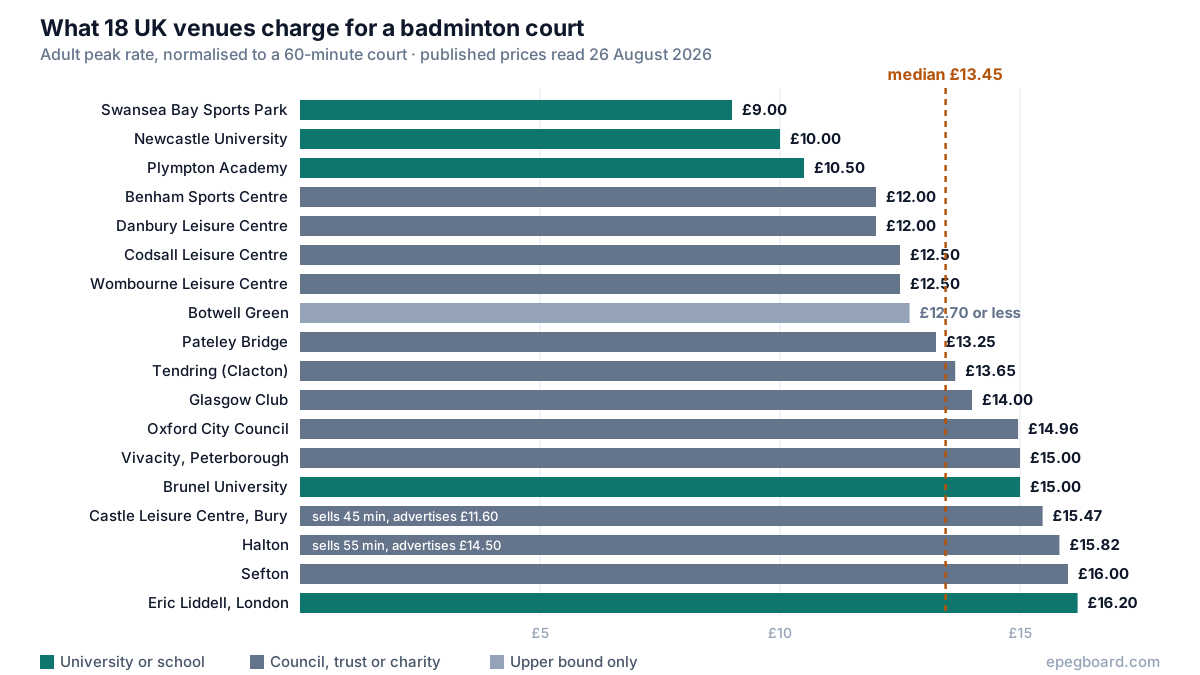
| Venue | Type | Advertised | Per hour | Fee year |
|---|---|---|---|---|
| Swansea Bay Sports Park | University | £9.00 | £9.00 | 2026/27 |
| Newcastle University | University | £10.00 | £10.00 | 2026/27 |
| Plympton Academy | School | £10.50 | £10.50 | 2026/27 |
| Benham Sports Centre | Charity | £12.00 | £12.00 | 2026/27 |
| Danbury Leisure Centre | Council | £12.00 | £12.00 | 2026/27 |
| Codsall Leisure Centre | Council | £12.50 | £12.50 | 2026/27 |
| Wombourne Leisure Centre | Council | £12.50 | £12.50 | 2026/27 |
| Botwell Green | Trust | up to £12.70 | up to £12.70 | 2026/27 |
| Pateley Bridge Leisure Hub | Council | £13.25 | £13.25 | 2026/27 |
| Tendring (Clacton) | Council | £13.65 | £13.65 | 2025/26 |
| Glasgow Club | Trust | £14.00 | £14.00 | 2026/27 |
| Oxford City Council | Council | £14.96 | £14.96 | 2026/27 |
| Vivacity, Peterborough | Trust | £15.00 | £15.00 | 2026/27 |
| Brunel University | University | £15.00 | £15.00 | 2026/27 |
| Halton | Council | £14.50 / 55 min | £15.82 | 2026/27 |
| Castle Leisure Centre, Bury | Council | £11.60 / 45 min | £15.47 | 2026/27 |
| Sefton | Council | £16.00 | £16.00 | 2026/27 |
| Eric Liddell, London | Independent school | £16.20 | £16.20 | 2026/27 |
The two rows in bold are the point of the whole table. Bury advertises £11.60, the fourth cheapest headline price in the survey. Converted to an hour it is £15.47, the fourth most expensive. Halton advertises £14.50 and moves from thirteenth to sixteenth the same way, which makes it the third dearest court in the survey.
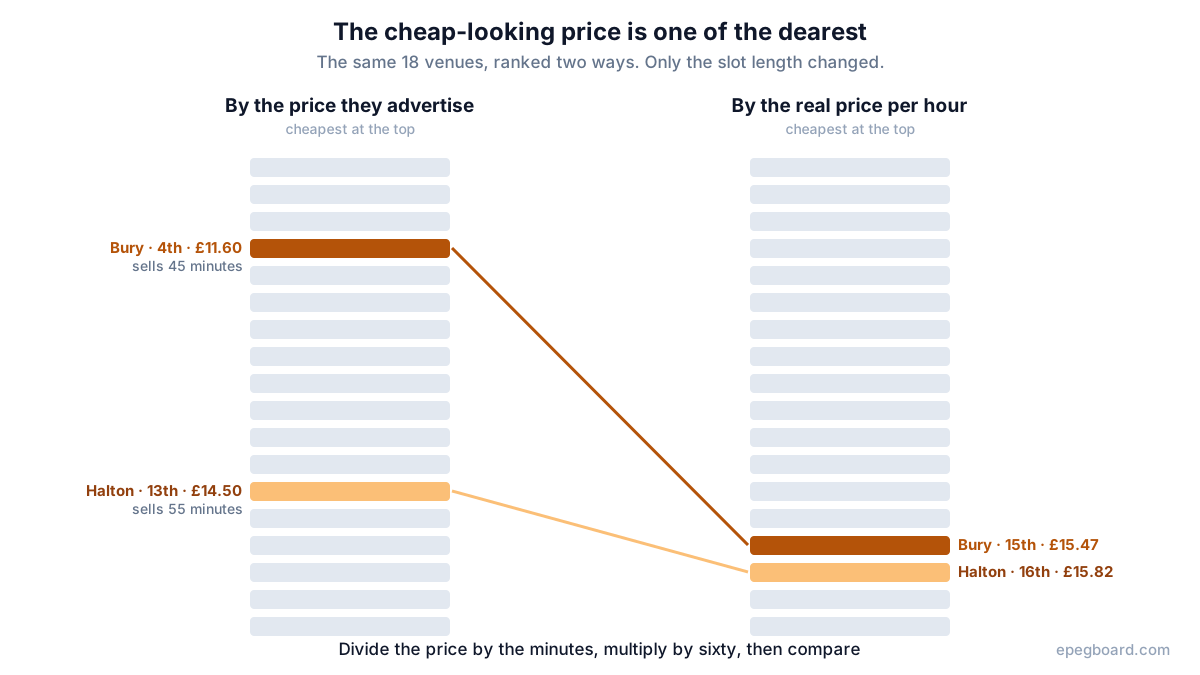
Divide the price by the minutes and multiply by sixty. That is the whole technique, and it is the only way two quotes mean the same thing.
Two caveats we will not bury. One of the eighteen rows is an upper bound rather than a price, because Botwell Green publishes "up to £12.70"; leaving it out moves the median to £13.65 and the upper quartile to £15.13, and leaves the lower quartile untouched. And one venue is still on 2025/26 prices where the rest are on 2026/27.
What drives the difference?
Operator type is the signal you can see, and region is not separable from it at any sample a club could reasonably gather.
| Operator | Venues | Median | Range |
|---|---|---|---|
| University | 3 | £10.00 | £9.00 to £15.00 |
| School | 1 | £10.50 | - |
| Trust or charity | 4 | £13.35 | £12.00 to £15.00 |
| Council | 9 | £13.65 | £12.00 to £16.00 |
| Independent school centre | 1 | £16.20 | - |
The three cheapest venues in the survey are two universities and a school hall. That is a real signal and it is worth acting on. It is not the same as saying education is cheaper, though, and we should be precise about the difference: Brunel University charges £15.00, above six of the nine councils, and the most expensive venue in the whole survey is an independent school's own sports centre.
We are not going to tell you how much of the variation is region, because our data cannot support it. All three North West venues are council-run, the only Welsh venue is a university, and the sample is eighteen. Any percentage we attached would be invented. Look at who runs the building before you look at where it is, and then go and check the specific places near you.
Is off-peak cheaper, and can your club use it?
Off-peak is the largest published discount in this survey, running 14 to 34 per cent below peak at the four venues that publish both.
Bury drops from £15.47 to £13.33 an hour, Sefton from £16.00 to £13.50, Benham from £12.00 to £10.00, and Halton from £15.82 to £10.47. That last one is a third off, and it is larger than Halton's own club rate, which is the point: the discount you have to ask for is smaller than the one already printed on the price list.
Nobody negotiates for this and everybody could. It is on the price list, it requires no conversation, and most clubs never look at it because the club night has always been on a Tuesday at eight.
The catch is real and it is about your members, not your budget. Off-peak usually means daytime or late evening, which suits retired players, shift workers, students and parents during school hours, and suits nobody in full-time work who wants to play at eight. For most clubs this is not a saving they can take. For a club with a daytime section, a juniors slot or an over-60s group, it is the cheapest court time available and it is sitting in plain sight.
Does block booking get you a discount?
Where a centre publishes a club or block rate the discount is large, and most centres do not publish one at all.
Halton Borough Council publishes badminton club hire at £10.90 for a 55-minute court against £14.50 casual, which converts to £11.89 against £15.82 an hour: a quarter off, for being a club.
Watch how block rates are listed. Tendring District Council's published block rate is £14.40, higher than its casual rate of £13.65. The 20 per cent discount for ten or more sessions on one invoice is applied separately, bringing it to £11.52, about 16 per cent below casual. A club comparing headline numbers would conclude that block booking costs more.
Everywhere else the club rate exists in some form and is not published. North Yorkshire refers to "reduced rates for block and club bookings" without a figure. Codsall and Wombourne both direct you to email. Better's Belfast centres take block bookings by enquiry only. We cannot tell you whether each of those centres holds a standard club rate or simply prices case by case, and neither can anyone else from the outside, which is the useful part: an unpublished price is one that gets set in a conversation.
When to stop negotiating
A guide like this can leave you feeling you should always be pushing. You should not.
If your normalised rate is at or below £12.00 an hour, you are in the cheapest quarter of everything we surveyed. If you also already hold a club or block rate, there is realistically nothing left on the table, and the time is better spent on filling the courts you have than on shaving the price of them.
Is VAT charged on court hire?
It depends on what kind of room you are hiring, not just on how you book it, and that is the part almost every guide skips.
Start with the building. HMRC treats letting facilities for playing sport as normally standard-rated at 20 per cent. But a general purpose hall, such as a village or church hall, that merely has floor markings is not classed as a sports facility, and letting it is exempt even when it is let for playing sport. School halls are treated the same way, provided it is the bare hall being supplied. Gymnasiums are excluded from that treatment.
And here is the trap, which sits directly on advice this guide gives elsewhere. If equipment such as racquets and nets is provided along with the hall, the supply becomes standard-rated sports facilities. So asking the village hall to put the posts and nets out for you can convert an exempt let into a taxable one. If you hire a bare hall and bring your own posts, ask before you change that arrangement.
Now the booking. For a genuine sports facility, a series of ten or more sessions can be exempt, unless the provider has opted to tax. All of the following must be true: ten or more sessions; the same sport each time; the same place; an interval of at least one day and no more than 14 between sessions; the series paid for as a whole with written evidence; the hirer a school, club or association; and exclusive use during each session.
Three of those conditions bite in practice. HMRC states plainly that there is no exception for an interval over 14 days caused by the facility closing for any reason, so a school-holiday break can end your series. The payment condition means the evidence must show payment is due whether or not each session is used, although a refund for the provider's own unforeseen non-availability does not affect this. And "unless the provider has opted to tax" is not a footnote: a commercial landlord who has opted to tax charges VAT regardless of your series.
What all this does not mean is that qualifying takes 20 per cent off your invoice. Whether exemption changes your price depends on who you are hiring from:
- A commercial operator currently charging you standard-rated hire: a qualifying series should remove the VAT, unless they have opted to tax. Whether the saving reaches you or is retained in their margin is a commercial question, not a tax one.
- A local authority: possibly nothing changes. Since Revenue and Customs Brief 3 (2023), HMRC has accepted that councils' leisure services can be treated as non-business and outside the scope of VAT, but that treatment is conditional and is adopted authority by authority rather than automatically. Contracted-out leisure services are a different case again.
- A charitable leisure trust: there may be a second route open to you. The sports exemption for eligible bodies applies to supplies made to individuals taking part, and HMRC's definition of "individual" expressly includes an unincorporated association booking on behalf of members, where the supplier is non-profit-making and the true beneficiaries are the people playing. That describes a lot of clubs hiring from a lot of trusts. It is worth asking about alongside the series-of-lets route rather than instead of it.
So do not walk in asking for 20 per cent off. Ask three questions instead: is our booking standard-rated at the moment, are we hiring a sports facility or a bare hall, and if we structure it as a series of ten or more sessions on one invoice, does that change the treatment? Those are answerable by the person who raises your invoice.
That the series rule shows up in real pricing is not theoretical. Sefton's published fees schedule notes that exemption applies to individuals and not-for-profit groups, "or when the block booking exemption can be applied", with standard rating otherwise.
Worked example: a club at Wombourne, 4 courts, 2 hours, 38 weeks
Wombourne Leisure Centre publishes £12.50 a court and £59.00 for the whole five-court hall.
- Four courts for two hours: 4 × 2 × £12.50 = £100.00 a week, or £3,800 over a 38-week season.
- All five courts for two hours: 5 × 2 × £12.50 = £125.00, so the hall at £59.00 × 2 = £118.00 saves £7.00 a week if you wanted all five anyway.
- But against the four courts you actually need, the hall costs £18.00 a week more. The fifth court and exclusive use are worth £18.00 a week to you, or they are not.
And the VAT? Wombourne is a district council leisure centre, so the supply may already be outside the scope under the 2023 position, in which case there is no 20 per cent to remove whatever your booking looks like. Ask them; do not assume it either way.
What else is negotiable besides the rate?
More is negotiable than the rate, though we should be straight about the evidence: no operator we could find publishes its block-booking terms, so this is a list of things worth asking for rather than a description of what is normal.
Worth asking for:
- A fixed court allocation and slot each week, rather than a floating one.
- Storage for posts, nets and a first-aid kit, which removes a job somebody currently does every week.
- Access and setup time, and whether your two hours includes putting the posts out. Check the VAT point above before asking them to supply equipment.
- A one-off tournament on your usual night without being re-charged as a new booking.
- What happens to your slot in the school holidays, which is also a VAT question if you are relying on a series.
And the lever most clubs never use: offer something back. A centre or school is not only selling court time, it has its own objectives, and a club can meet them cheaply. A taster session for the school's pupils, an after-school club, a junior section that feeds the venue's own programmes, or simply filling a slot that is otherwise dead are all worth real money to the person you are negotiating with. This is the only lever available to a club with no alternative venue, and it is the one this guide would push hardest.
Is the whole hall cheaper than the courts inside it?
The whole hall can be cheaper than taking every court in it, but it is dearer than taking one court fewer at every venue we surveyed, so the arithmetic decides it.
Multiply the per-court rate by the number of courts in the hall and compare it to the whole-hall price:
| Venue | Whole hall | Every court | One court fewer |
|---|---|---|---|
| Codsall (5 courts) | £59.00 | £62.50 - hall cheaper | £50.00 - hall dearer |
| Wombourne (5 courts) | £59.00 | £62.50 - hall cheaper | £50.00 - hall dearer |
| Newcastle University (8) | £80.00 | £80.00 - level | £70.00 - hall dearer |
| Plympton Academy (4) | £42.00 | £42.00 - level | £31.50 - hall dearer |
Three other venues in our survey publish a whole-hall price and no court count, so their halls cannot be converted at all and we have not guessed at them.
What the table says is narrower than the usual advice. If you want every court in the hall, ask for the hall price, because at two of four venues it is cheaper and at the other two it costs the same while adding exclusive use. If you want fewer courts than the hall holds, the hall is dearer, and the question becomes what exclusivity is worth to you: no five-a-side in the next bay, no pay-and-play queue at the door, and room to spread out when forty people turn up instead of thirty.
Who do you talk to, and when?
Talk to a named administrator or centre manager rather than the booking desk, and do it months before April when new prices take effect.
Centres route block enquiries away from reception. LeisurePlex in Lisburn directs block bookings to a named administrator, and Codsall and Wombourne both direct them to the centre's email rather than its phone line. The inference we draw from that, and it is an inference rather than something anyone publishes, is that the booking desk holds a price list rather than any authority to depart from it.
The timing matters more than the routing, at councils specifically. Council leisure prices are set annually with effect from 1 April, and they go through committee as published papers. Sefton's 2026/27 sports fees appeared as a committee document showing the current charge, the proposed charge and the percentage increase. Oxford publishes the same thing, and Halton's schedule is captioned "subject to approval".
So next year's council price is a public document months before your renewal letter arrives. Search your council's website for its fees and charges paper and find the sports pages. Universities, trusts and schools do not work this way, so this particular trick is a council one.
One warning that this guide learned the hard way. A committee paper is a proposal, and the column headings matter: these documents typically show the current year, an inflation-adjusted figure and the proposed new charge side by side. Read the wrong column and you will quote a price that is a year out or one that was never adopted.
Is the venue bound by a community use agreement?
A school or academy sports hall may be covered by a community use agreement that governs its pricing policy, and it is worth finding out because these agreements are public documents.
Sport England publishes guidance on community use agreements and says they should typically cover hours of availability, management arrangements and pricing policy. It also recommends that such an agreement is secured through a condition on the planning permission for the development, which is the useful part for you: a planning condition is on the public planning record.
So if you hire a school hall built or extended in the last twenty years or so, look up the school's planning application on your local authority's planning portal and see whether a community use agreement was required. What it says about pricing is specific to that agreement, and we are not going to characterise it for you, because the terms are negotiated per site and Sport England's own material is a template to be adapted rather than a fixed obligation.
We cannot tell you whether your venue has one. But no other guide on this subject will tell you the lookup exists, and a club that finds one is having a different conversation from a club that opens with "could you do it a bit cheaper".
Which contract terms matter as much as the rate?
Cancellation, variation and notice terms matter as much as the rate does, and this is the one question in this guide where the honest answer is that nobody publishes the standard.
We went looking for what a normal leisure-centre block-booking agreement contains and found nothing public at any operator. Rather than invent a norm, here is what to get in writing before you commit to a series:
- What notice must they give to cancel or move a session, and what happens to sessions already paid for.
- What notice must you give, and how many sessions you may cancel without losing the block rate. Remember the VAT trade: a series that qualifies for exemption is one you have agreed to pay for whether or not you use it.
- Whether the rate is fixed for the term or reviewed on 1 April regardless.
- What happens when the hall is taken for an exam, a polling station or a school production.
- Whether your allocation carries over automatically at renewal, or is re-offered.
That last one is worth more attention than it usually gets. A block that has to be reapplied for each year is a block you can lose to whoever asks first.
What do you need ready before you ask?
Have evidence of public liability cover ready, a named person who can sign, and answers to the safeguarding questions a venue will ask if juniors are involved.
A centre letting a regular block will normally want to see that the club is insured, and for many clubs that cover comes through national affiliation rather than a separate policy. Check what your affiliation actually covers, because it is probably not what you assume. Badminton England publishes a benefits table showing public and products liability for players under the individual memberships and for club administrators under club affiliation. Affiliating the club does not put liability cover behind every person who turns up on a Tuesday; their own individual membership does that.
Beyond insurance, expect to be asked for some of: a constitution, a bank account in the club's name, a named signatory, your safeguarding policy and DBS position if juniors attend, a risk assessment, first-aid provision and who your first-aider is, and how incidents get reported. Schools ask more of this than leisure centres do, and they ask it earlier.
When should you walk away?
Walk away only when there is somewhere else to go, and for a lot of clubs there is not.
Start with the honest version. Most clubs have one hall that is the right size, in the right place, at the right time of the evening. If that is you, "walk away" is not a lever, and pretending otherwise wastes your time. What you have instead is off-peak, the block structure, and the offer-something-back play above, none of which needs an alternative.
But if you have not looked, look, because the three cheapest venues in our survey were education venues. School lettings are published by the hour through letting platforms such as SchoolHire, and facility finders including Playfinder and Sport England's Active Places Power will show you what physically exists near you. Both are free and neither requires you to talk to anyone.
To compare a whole-hall price against a per-court rate you need the court count. Sport England's design guidance gives a four-court hall as 34.5 by 20 metres, revised up from a previous 33 by 18 metre standard. A listing that gives dimensions can be converted with that. A listing that gives neither dimensions nor court numbers cannot, and we would not guess.
What you usually give up moving to a school is parking, changing rooms, a bar, and the caretaker's goodwill on the night somebody is ill. Price the move, then decide.
If you only do one thing
Work out what your centre charges per hour before you compare it to anything. A 45-minute court at £11.60 is the fourth-cheapest advertised price in our survey and the fourth most expensive in reality.
Fair games, without the admin
ePegboard has nothing to do with your court hire. What it does is make the courts you have already paid for go further: it picks balanced games on a club night and keeps court time even across everyone who turns up, so the hall you are negotiating over is not sitting half-used while four people sit out. Free for clubs.
Frequently asked questions
Should we hire more courts than we need so nobody sits out?
Usually no. An extra court costs the same every week whether it is busy or not, and sit-outs are more often a rotation problem than a capacity one. Work out what your busiest realistic night looks like, hire for that, and fix the queue rather than buying your way out of it.
Can we sublet spare courts to another group?
Ask, because we cannot tell you. No operator we looked at publishes its block-booking terms, so we have no basis for saying what is normal here. It is worth asking directly: a second group sharing your block is one of the few things that lowers your cost per player at all.
Is it cheaper to run two shorter nights or one long one?
Two nights almost never costs less, because the price is per court-hour either way and you double your exposure to peak pricing. It can still be the right call for other reasons, such as splitting standards or fitting more members into a small hall, but treat it as a membership decision rather than a saving.
Do we have to be affiliated to hire a council hall?
Not usually for the booking itself, but a centre will normally want evidence of public liability cover before letting a regular block, and affiliation is a common route to that. Be careful which affiliation: Badminton England's own benefits table puts player liability cover under individual membership and club-administrator cover under club affiliation, so the two do different jobs.
What if the centre wants to move us to a different night?
This is why the variation and cancellation terms matter as much as the price. Ask what notice they must give to move or cancel a session, and what happens to sessions you have already paid for. If the answer is vague, get it in writing before you commit to a series.
Would registering as a CASC make court hire cheaper?
Not directly. CASC status affects rates relief and tax treatment for the club itself, not what a leisure centre charges you. It matters more if your club owns or leases its own facility, which is a different situation from hiring one.
What about hiring a school hall during the holidays?
School lettings are often the cheapest option in a given town, but term-time and holiday availability are usually governed separately, and a hall available in June may be shut in August. If your season runs through the summer, ask about holiday access before you move.
Where to go next
If you are hiring courts because you are setting a club up from scratch, the venue is one of five things you need at once. How to start a badminton club covers the others: players, kit, fees and your first sessions.
Once the hall is booked, your cost per player depends entirely on how full the courts are. Giving everyone fair court time on a busy night deals with the sit-out problem directly, and the complete organiser's checklist covers the rest of the evening.
The next question after "what does the hall cost" is usually "what do we buy with the rest of it". Shuttles are the other recurring line, and feather vs nylon: what your club should buy works out the cost per session the same way this guide works out the cost per court.
How this guide was put together
ePegboard builds club-night software. We do not hire out courts, we are not tax advisers, and we have never negotiated a court-hire contract. The prices here come from a survey we ran ourselves: on 26 August 2026 we read the published rate cards and booking pages of 24 UK venues and recorded every figure with its source and its fee year. Eighteen sell a comparable per-court unit and those are the ones in the chart and table.
The VAT section is compiled from HMRC's published notices, and where the treatment depends on your supplier or your building we have said so rather than picking the answer that sounds most useful. Where we could not find a source we have said that too: no operator publishes its block-booking terms, no published figure exists for what clubs actually negotiate off list price, and we found no published badminton rate at any Northern Ireland venue.
Sources: HMRC, VAT on land and property (Notice 742) · HMRC, Sport supplies that are VAT exempt (Notice 701/45) · Revenue and Customs Brief 3 (2023): local authority leisure services · Sport England on community use agreements · Sport England sports halls design guidance · Sefton Council fees and charges 2026-27 · Tendring District Council schedule of fees and charges · Halton Borough Council sports fees 2025/26
Published 26 August 2026 by ePegboard. Prices read 26 August 2026; 17 of the 18 comparable venues are on 2026/27 fee years and one on 2025/26.