

Feather is still the better fit for most experienced club play and many league fixtures. Nylon is usually the sensible choice for beginners, schools and sessions where durability matters most. But the interesting part is everything hidden inside that simple answer.
A tube of feather shuttles can cost several times as much as a tube of nylon. That makes the buying decision look obvious until you notice that the tubes often contain different numbers of shuttles, the products fail in completely different ways, league rules vary by division, and the newest synthetic shuttles are no longer confined to leisure-centre practice courts.
So this is not a debate about whether feather is "better". It is a question of what you are buying the shuttle for, what standard your players expect, and what each playable hour actually costs your club.
The practical answer
- League fixtures: use whatever the current rules for your division require. Do not assume.
- Experienced club nights: feather is usually preferred where players are accustomed to it and the budget supports it.
- Beginners, schools and high-volume coaching: nylon is usually the more practical default.
- Mixed-purpose clubs: there is nothing wrong with stocking more than one type.
- Cost: compare price per shuttle and then measure how many your club actually retires per session.
- Synthetic feather: treat it as a separate emerging category, not as another name for ordinary nylon.
Prices and product ranges were checked in the UK on 26 August 2026. They move quickly, so the examples below are there to show the arithmetic rather than provide a permanent price list.
In this guide
What actually feels different? Which is cheaper in practice? How do feather shuttles actually fail? Does expensive feather fly better? What does your league require? Where does the shuttle bill come from? What changed with synthetic shuttles in 2026? What should beginners and juniors use? How do you choose the right speed? How should feather shuttles be stored? What should your club buy? Frequently asked questionsWhat actually feels different?
A feather shuttle and a traditional nylon shuttle are trying to solve the same aerodynamic problem with very different structures.
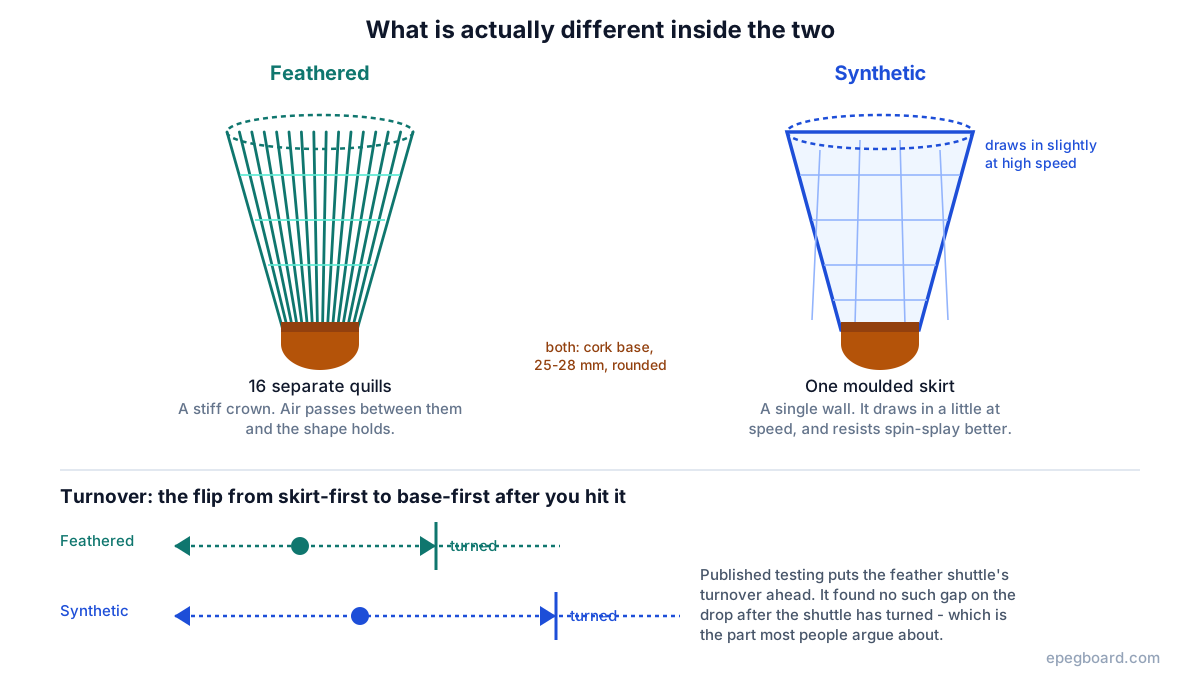
A feather shuttle has sixteen individual feathers fixed into its base. A traditional nylon shuttle replaces that crown with a moulded synthetic skirt. Both are designed to turn cork-first after contact and then lose speed extremely quickly, but they do not perform that transition in exactly the same way.
The most useful controlled research we found is a doctoral study from Nanyang Technological University that tested multiple feather and synthetic shuttles in flight. Its clearest result was not that synthetics simply "fly badly". It found feather shuttles had better turnover stability after launch, while differences in the later part of the trajectory were much smaller. The study's tested synthetic shuttles also showed no disadvantage in the quality of the post-vertex drop once the shuttle had settled into flight.
That distinction matters because it is close to what experienced players describe without using aerodynamic language. Feather tends to feel more predictable immediately after contact: on a spinning net shot, a block, a sliced stroke or a fast change of direction. Saying only that feather "drops more steeply" misses the more interesting difference.
There is also a measurable high-speed effect, although it is easy to overstate. The NTU study reports Cooke's earlier measurement of the tested synthetic skirt reducing by about 1 mm in diameter at 38 m/s, while the feather shuttles showed no observable deformation. That changes drag. But the later NTU analysis calculated that even a 2 mm reduction in frontal diameter would change the drag coefficient by only about 0.03, and questioned how important the mechanism was in practice. The deformation is real; treating it as the whole explanation for why synthetic shuttles feel different is not.
Which is cheaper in practice?
Nylon normally wins on lifetime cost, but the usual tube-price comparison exaggerates the difference before durability has even entered the calculation.
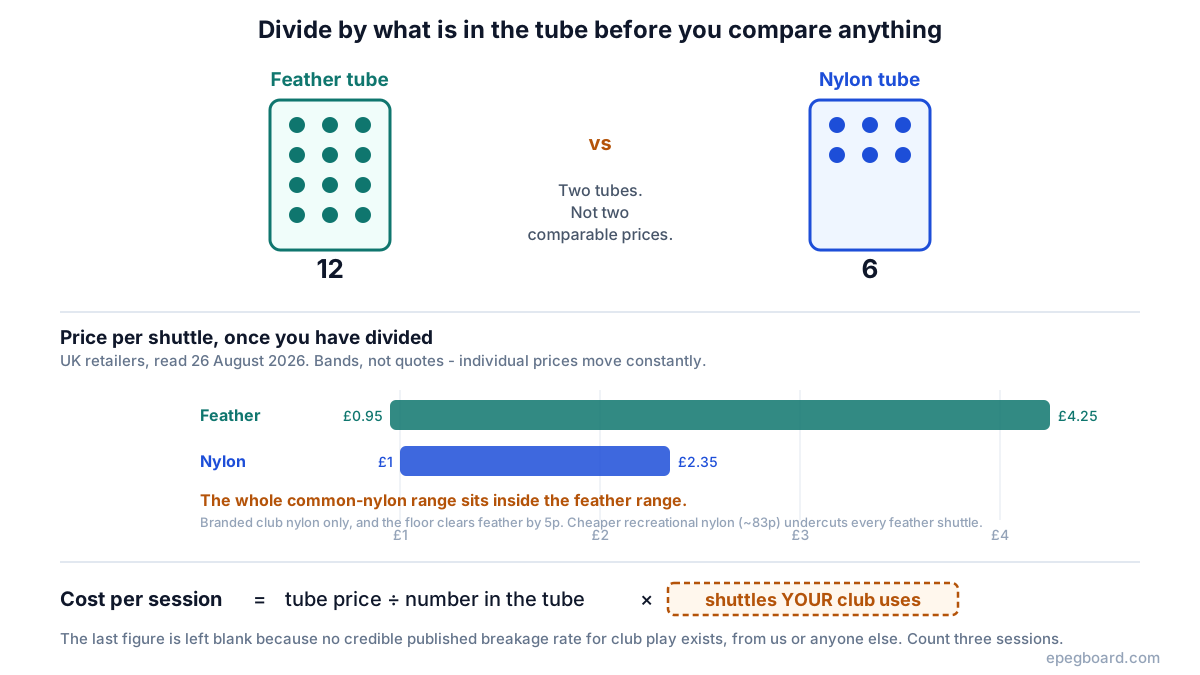
Never compare tube with tube. Compare shuttle with shuttle first. Mavis-type nylon is commonly sold in sixes; feather is normally sold in twelves. A £14 nylon tube beside a £40 feather tube therefore does not mean feather costs nearly three times as much per shuttle.
Our UK retailer snapshot on 26 August 2026 found feather at roughly £11 to £51 for twelve and common nylon tubes of six from about £6 to £14. Converted to individual shuttles, that is approximately 95p to £4.25 for feather and about £1 to £2.35 for common nylon.
Which produces the awkward result: the whole common-nylon range sits inside the feather range. The cheapest feather shuttle we found costs less per shuttle than any common nylon one, and the dearest nylon costs less than most feather. Tube prices tell you almost nothing.
Two honest qualifications on that "about £6". It is where recognisable branded nylon starts, not the bottom of the UK market. At the time of reading, Victor 500 and Carlton T800 and C100 were £5.99 for six at one specialist and Yonex Mavis 10 was £6.50 at another, while the mainstream Mavis 300 and 600 that most clubs actually buy ran nearer £11 to £14. Below all of that sit recreational and coaching shuttles - Zsig lists six at £4.99, about 83p each - which are cheaper per shuttle than any feather shuttle we found. Count those and the overlap claim above stops being true. The band is deliberately scoped to shuttles a club would put on court rather than to the cheapest product on the internet, and that scoping is doing real work, so we would rather show it than bury it.
That does not make cheap feather the cheaper way to run a club. It simply shows why headline tube prices are a poor comparison. Durability is the second half of the calculation.
We are giving you bands rather than a price list on purpose. Individual prices move week to week, and while we were reading them they differed between a retailer's own category page and its product page. A table of forty figures would be out of date before you read it. Take your own retailer's numbers and put them through the arithmetic below.
Then comes the part nobody can sensibly calculate for you: how long a shuttle lasts in your club. Player standard, mishits, powerful smashes, humidity and the club's tolerance for worn feathers all change the answer. A feather shuttle that one group discards after a bent feather may survive several more games in another club.
Measure your real shuttle cost
- Start a session with a known number of match-ready shuttles.
- At the end, count how many have been retired from normal games.
- Record roughly how many games and court-hours were played.
- Repeat for at least three normal sessions.
- Divide the shuttle spend by sessions, games or court-hours - whichever measure is most useful to your club.
That figure describes your players, your hall and your standard for replacing a shuttle. We could not find a credible published breakage or retirement rate for ordinary club-level play, so a precise universal "games per shuttle" number would be false precision.
One durability claim is worth correcting because it is frequently repeated in the wrong comparison. Yonex says its Mavis range offers "four to five times more durability than an ordinary nylon shuttlecock". The comparison is Mavis versus other nylon, not nylon versus feather. It cannot be used as evidence that a nylon shuttle lasts four or five times as long as a feather one.
There is one broader durability statistic worth keeping in proportion. When BWF announced its synthetic-feather programme in 2020, it said tournament testing had reduced shuttle usage by up to 25%. That is encouraging evidence for that particular technology and setting; it is not a universal nylon-versus-feather multiplier for a Wednesday club night.
How do feather shuttles actually fail?
A feather shuttle can become unusable in two quite different ways. One is sudden: a feather shaft snaps or the crown is badly damaged by a smash or mishit. The other is gradual: the vanes wear and splay, the shuttle's behaviour deteriorates, and eventually somebody decides it is no longer good enough for a game.
That distinction matters because the formal durability test is much better at measuring the first failure than the second. The BWF approval procedure uses repeated smash impacts; the NTU research notes that this tests smash durability but does not capture the slower degradation caused by feather wear during lower-intensity use. That is a much closer description of how many club shuttles spend their final few games.
The buying consequence is useful. If your club mostly destroys shuttles through sudden impact damage, resistance to breakage matters enormously. If most are retired because they gradually become ragged and unpleasant to play with, the official smash test does not directly measure the thing costing you money. Watch how your own shuttles die, not just how the grade is described on the tube.
Does expensive feather fly better?
Not necessarily in the way players often assume.
In the NTU study, the tested feather shuttles ranged from economical practice grades to BWF-approved tournament models. When new, their measured flight trajectories were very similar. The more expensive tournament-grade shuttles separated themselves under wear: they resisted vane damage better and showed less degradation in flight performance.
That suggests a much more useful way to think about feather grades. You may be paying less for a different trajectory than for a longer period of acceptable trajectory. Higher-grade shuttles can also have a stiffer crown and a different feel off the strings, so durability is not literally the only distinction, but "premium means it flies properly" is too simple.
For a club buyer, this turns the cheap-versus-expensive feather argument into arithmetic. If a £30 tube lasts materially longer than a £20 tube in your sessions, the dearer shuttle can be cheaper to use. If both are routinely discarded for the same reasons at the same rate, it cannot.
What does your league require?
This is the easiest part of the buying decision and one clubs still get wrong: read the current rules for your own league and division.
There is no single English league rule. Four examples show how different the position can be:
| League | Current rule |
|---|---|
| Exeter & District | Home teams provide feathered shuttles conforming to Badminton England rules |
| Solihull District | Committee-approved shuttles generally; feather compulsory in Division 1 |
| Coventry | Premier: feather; Division One: approved feather or synthetic hybrid, with broader permission in lower divisions |
| Birmingham | Feather in Division One; home team chooses an approved type elsewhere, with cork-based plastic recommended |
Those rules also illustrate another budgeting point: the home team commonly supplies the match shuttles. If your club plays league badminton, count home fixtures separately from ordinary club nights. Match-grade stock is a different budget line.
Where does the shuttle bill come from?
For most clubs, shuttle spending is buried inside subs or a session fee until somebody notices that the box bought at the start of term has disappeared rather faster than expected.
Split the budget into two parts. Club-night usage rises mainly with the amount of badminton being played: courts, hours and games. Fixture usage is driven by the home matches for which your rules make the club responsible for supplying shuttles. A club can therefore add league teams without adding many members and still create a noticeable new shuttle bill.
There is also a market reason feather bills have become more painful, and it is covered under synthetic shuttles below: an international shortage of suitable feather. It does not tell you what your next tube will cost, but it does explain how a club can buy the same grade in the same quantities and still watch the budget move sharply.
Once you know your measured cost per club night and your expected home-fixture requirement, shuttle spending stops being an unpleasant surprise and becomes an ordinary budget line. That is a much better basis for deciding whether subs need to change than arguing from the price printed on one tube.
What changed with synthetic shuttles in 2026?
The old choice was easy to describe: natural feather for serious badminton, moulded nylon for durability. That boundary is becoming less useful.
In April 2026, BWF approved two named synthetic shuttlecocks - the Victor New Carbon Sonic Max and Yonex Crosswind 70 - for use at selected Grade 3 and Junior International tournaments as part of an evaluation programme. BWF is collecting manufacturer data and feedback from players, officials and organisers before deciding how far the technology should go.
This does not mean the ordinary nylon shuttle in a leisure-centre cupboard has suddenly become equivalent to tournament feather. The newer products use more elaborate structures intended to reproduce feather behaviour more closely. It does mean that "synthetic equals practice shuttle" is now an outdated category distinction.
The 2026 move also matters because feather supply has become more expensive and volatile. ABC News reported in August that avian-flu-related poultry losses had reduced the supply of suitable feathers, alongside other cost pressures. Badminton Australia said the price of a tube of Yonex AS-30s in Australia had risen from roughly A$30-35 a decade earlier to well over A$70.
For a UK club, the immediate conclusion is not to switch. Availability, local rules, player acceptance and real durability all still matter. The conclusion is simply that synthetic feather is now worth watching as its own category.
What should beginners and juniors use?
Nylon is usually the sensible default, mainly because beginners are exceptionally good at hitting the part of a feather shuttle that dislikes being hit.
A clean stroke transfers force through the cork. A mishit can catch and damage the feather crown directly. Put twenty learners through repetitive drills with feather shuttles and the equipment bill can become the lesson.
That is not quite the same as saying beginners should never use feather. Coaches sometimes prefer players to learn with the shuttle they ultimately want them to control, particularly once touch, net play and more advanced stroke timing matter. A practical progression is often nylon for high-volume early learning, with feather introduced when there is a coaching reason for it rather than simply because stronger players use it.
How do you choose the right speed?
Shuttle speed depends on the conditions in the hall, not just the label on the tube.
BWF's test is wonderfully low-tech. Hit a full underarm stroke from above one back boundary line, upwards and parallel to the sidelines. A correctly paced shuttle should land between 530 mm and 990 mm short of the opposite back boundary line.
Temperature matters because colder, denser air creates more drag. In colder conditions you generally need a faster shuttle; in warmer conditions a slower one. Numbered feather speeds and manufacturers' nylon temperature grades are not always expressed on the same scale, so use the manufacturer's guidance and then test the shuttle in the actual hall.
Yonex's current Mavis range makes the principle explicit: its slow version is aimed at warmer conditions, medium at moderate temperatures and fast at colder conditions. The court test is still the useful final answer.
How should feather shuttles be stored?
Feather shuttles dislike being dried out. A brittle feather shaft is more likely to fail, which is why badminton has accumulated a small folklore industry around humidifying and steaming tubes.
The sensible part is straightforward: keep tubes closed, avoid hot cars and radiators, and do not leave season-long stock in an excessively dry cupboard if you can avoid it. Clubs often condition dry shuttles before play with moisture or brief steaming.
What we would not do is pretend there is a scientifically established magic humidity or steaming time. The practice is widespread and mechanically plausible, but controlled evidence for the exact club routine is thin. Treat conditioning as practical maintenance, not alchemy.
So what should your club buy?
If your players are happy, your league rules are satisfied and the shuttle budget is under control, there may be nothing to fix.
For everyone else, the most sensible buying policy is usually based on the session rather than on loyalty to one tube:
| Session | Good starting point | Why |
|---|---|---|
| Junior / beginner | Nylon | Durable, predictable and tolerant of mishits |
| High-volume coaching | Nylon, with feather where coaching requires it | Keeps repetition affordable without banning feather from skill development |
| Experienced club night | Mid-grade feather if players expect feather | Better turnover feel, with cost controlled through grade choice |
| League fixture | Whatever your division requires | Compliance comes before preference |
| Synthetic-feather trial | Test before standardising | The technology is moving quickly; player acceptance and local rules still vary |
And if the committee wants to know whether a switch will save money, do not settle it by arguing about how many games a shuttle "should" last. Put both products through three representative sessions and count them. Badminton has enough opinions already; this is one decision where your club can have its own data.
If you only remember one thing
Compare cost per session, not cost per tube. Pack sizes differ, durability differs, and the cheapest shuttle to buy is not necessarily the cheapest shuttle to play with.
Know what actually happened on your club night
ePegboard runs the rotation, balances games and keeps the session moving. It also gives you a record of the games that were played - useful context when you want to understand what a night cost rather than guess from a half-empty box of shuttles. Free for clubs.
Frequently asked questions
Are feather shuttlecocks always better than nylon?
For experienced players, feather generally gives the more familiar feel and more stable turnover after the hit. But that does not make it the right choice for every session. Nylon is usually the practical option for beginners, schools, many coaching sessions and clubs where durability matters more than matching feather behaviour exactly.
Are nylon shuttlecocks actually cheaper?
Usually over time, because they tend to last much longer, but do not compare tube prices alone. A common Mavis tube contains six shuttles while feather tubes normally contain twelve. Compare price per shuttle and, better still, your club's actual cost per session.
Can a badminton league require feather shuttles?
Yes. Rules vary by league and sometimes by division. Some require feather throughout, some require it only in their highest divisions, and some permit approved plastic or hybrid shuttles. Check the current rules for your own league before buying match stock.
Should beginners use feather or nylon shuttles?
Nylon is usually the sensible default because it survives mishits and repeated coaching use much better. There is a coaching argument for introducing feather earlier because it rewards the timing and touch players will eventually need, so a coach may deliberately use both.
Do feather shuttlecocks need special storage?
They are more vulnerable to dry conditions than nylon shuttles. Keep them away from excessive heat and very dry storage. Clubs often condition dry feather shuttles before play, but there is much more practical tradition than controlled research behind exact humidity or steaming routines.
What changed with synthetic shuttles in 2026?
BWF approved two named synthetic shuttlecocks from Victor and Yonex for use at selected Grade 3 and Junior International tournaments as part of an evaluation programme. That does not make traditional nylon equivalent to tournament feather, but it does show that the gap between natural feather and engineered alternatives is being taken seriously at international level.
Where to go next
If you are equipping players as well as the club, how to choose a badminton racket explains the specifications that actually matter and the ones that get over-sold.
If you are setting up from scratch, how to start a badminton club covers venue, players, fees and equipment. And if your bigger problem is keeping a busy evening fair, see how to organise badminton club-night rotation.
How this guide was put together
ePegboard does not sell shuttlecocks and has no affiliate arrangement with a shuttle manufacturer. This guide draws on the BWF Laws of Badminton, BWF's announcements on synthetic shuttle development, published academic research on shuttle flight and durability, current English league rules, manufacturer specifications and UK retailer prices checked on 26 August 2026. We found no credible published breakage or retirement rate for ordinary club-level play; where the article recommends measuring your own club, that absence is the reason rather than an omission.
Sources: BWF Laws of Badminton · BWF synthetic shuttle evaluation, April 2026 · BWF synthetic-feather programme, 2020 · Lin, Understanding and Evaluation of Badminton Shuttlecocks Through Flight Dynamics and Experimental Approach · Coventry Badminton League rules · Birmingham Badminton League rules · Exeter & District Badminton League rules · Solihull District Badminton League rules · ABC News on feather supply and shuttle prices, August 2026 · Yonex UK shuttlecock range and pricing · Badminton HQ shuttle pricing · Direct Badminton shuttle pricing example · Zsig recreational shuttle pricing
Published 26 August 2026 by ePegboard. Prices checked 26 August 2026.