

Start with weight, shaft stiffness and balance. They will not identify one perfect racket, but they remove most of the obviously unsuitable ones. For an adult buying a first or second club racket, 4U is an excellent place to start; avoid an aggressively stiff shaft unless you already know you like one; and choose a neutral or moderate balance rather than buying head-heaviness as a promise of power.
Then look at price. In our snapshot of 228 adult rackets at one UK specialist, the versatile combinations were concentrated below £80. Above that, the catalogue did not become a simple ladder of improvement - it branched into more specialised preferences. That is the important distinction. A £180 racket can be an excellent racket and still be the wrong upgrade for you.
The short version
- Start around 4U, with a non-extreme shaft and balance. 5U can be attractive if you value manoeuvrability; 3U can be perfectly sensible if you already know you prefer more mass.
- In our retailer snapshot, £30 - £80 was the useful sweet spot. Above it the range became more specialised rather than universally better.
- Check whether it comes strung. Above £120 most of the rackets we counted did not, and a restring is another £15 to £30.
- Moving mass towards the head did not increase shuttle speed in a controlled study of twenty players of regional to international standard. That is measured, not opinion.
- Where you hit the shuttle and how fast you swing matter enormously. In elite smash data those two explain most of the variation in how fast the shuttle leaves.
Written for adults buying a first or second badminton racket in the UK, playing club or social badminton. Market figures come from our own count of 228 adult rackets in Badminton HQ's catalogue on 23 August 2026, with the trends checked against Central Sports. Specifications are the retailers' own product tags describing how each racket is marketed, not measurements we took.
We have no commercial relationship with any racket manufacturer or retailer, and no link on this page earns us a commission. The full method is at the foot of this guide.
In this guide
Which specs actually decide it? How much should you spend? What does the cheap shelf actually sell you? What do the Laws require? Weight: what do 3U, 4U and 5U mean? Does a head-heavy racket make you hit harder? Shaft flex: stiff or flexible? Does it come strung? Grip size: does it matter? What should you ignore? Can you try before you buy? How much does the racket matter? Frequently asked questionsWhich specs do most of the useful narrowing?
Start with weight, shaft stiffness and balance. Manufacturers publish plenty of other numbers, but these three change the basic handling of the frame enough to be useful filters before you worry about model names and technologies.
Grip size is a fit check rather than a choice, and the UK market largely makes it for you. String tension is a real decision but not one you make when you buy, because it recurs every few months and because under about £100 the racket almost always arrives already strung. That leaves three.
There is a sixth thing that matters more than two of the five and is not counted as a spec at all: whether the racket comes with strings in it.
How much should you spend?
For a first or second club racket, there is no obvious need to spend into three figures. In the catalogue we counted, roughly £30 to £80 contained most of the versatile 4U/5U, non-stiff, even-balanced options, often already strung. That is a snapshot of one retailer on one day, not a permanent price law - but it is a useful warning against assuming that price maps neatly onto suitability.
We counted 228 adult rackets in one UK specialist retailer's catalogue to check this, and cross-checked the direction of travel against a second. Plenty of guides will name you a price. What none of the ones we checked does is count what the market actually stocks at each one.
Once you count, what the catalogue shows is not a plateau. It is a shelf that steadily stops stocking the thing you want.
| Price band | Rackets | 4U or 5U | Head-heavy | Stiff shaft | Marketed to beginners |
|---|---|---|---|---|---|
| Under £30 | 26 | 4% | 19% | 8% | 92% |
| £30-49 | 33 | 73% | 30% | 6% | 58% |
| £50-79 | 32 | 75% | 34% | 9% | 31% |
| £80-119 | 57 | 65% | 54% | 18% | 0% |
| £120-179 | 58 | 66% | 55% | 40% | 0% |
| £180+ | 22 | 45% | 64% | 73% | 0% |
Count the rackets that match the whole club specification at once, and the picture is starker. Sixteen of the 228 are 4U or 5U with even balance, a medium or flexible shaft, and strings included. Thirteen of those sixteen cost under £80, and they start at £24.95. None of the twenty-two rackets above £180 match, and not one racket above £80 is marketed to a beginner at all.
There is no conspiracy in this. Premium rackets are marketed to and through professionals, and the expensive end of the catalogue is built around particular preferences - stiffer, more often head-heavy, and sold unstrung so the player picks their own tension - rather than around a safe default.
That does not make the expensive end a ladder, and it is worth being clear that head-heavy is not what "advanced" means. Even above £180, where two rackets in three are head-heavy, nearly a quarter of the ones we counted are head-light - including the two cheapest in that band. The premium shelf is not one direction of travel but several, each built around a preference somebody has already formed. The £200 racket is better at being a specialised racket. The mistake is assuming that axis points at you.
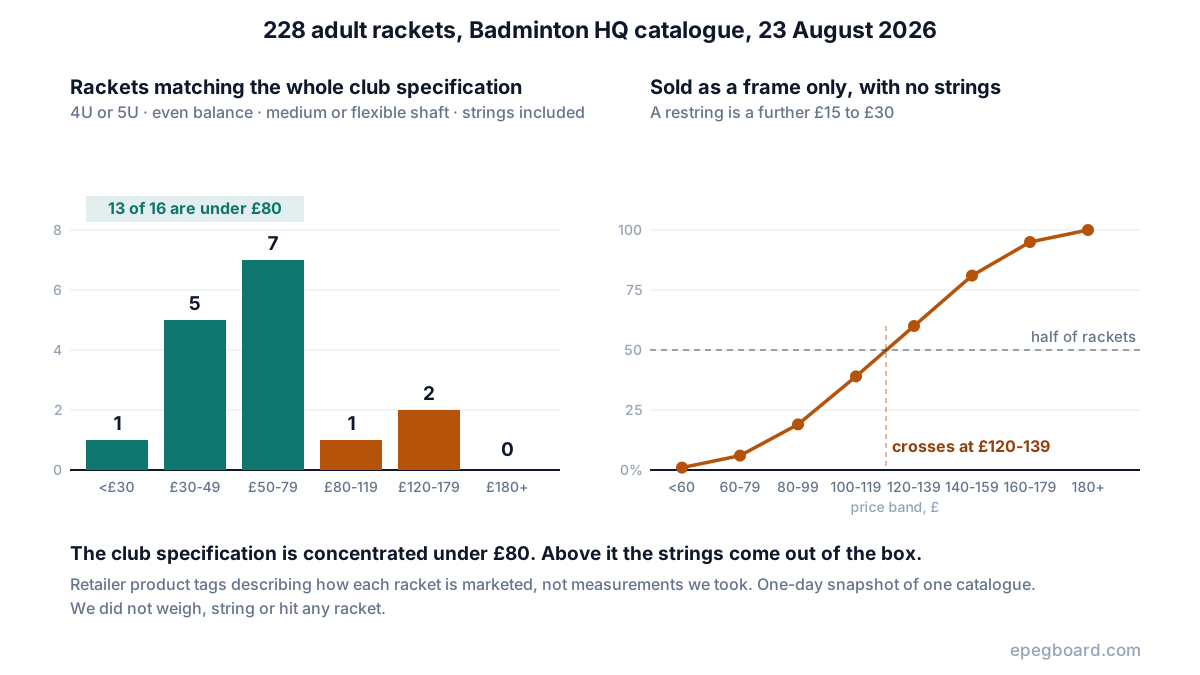
In short: treat about £30 - £80 as the sweet spot our snapshot found, not as a ceiling. Spend more when you can name the characteristic you are paying for.
What does the cheap shelf actually sell you?
The cheap shelf sells you a heavier racket, which is the opposite of what most people assume. Of the twenty rackets under £24 we counted, seventeen were 1U or 2U, meaning 90 g and up, including budget lines from brands you have heard of. The first 4U appears at £24.95, and between £30 and £80 about three rackets in four are 4U or 5U.
So the concrete upgrade from a £15 supermarket racket is not carbon fibre or a bigger sweet spot. It is dropping something between five and fifteen grams off a frame of ninety or more - six to ten if you buy 4U, more if you buy 5U - which is enough to make the racket easier to accelerate and reposition.
What do the Laws require?
The Laws of Badminton regulate whether a racket is legal, and almost nothing about how it plays. Law 4 caps the frame at 680 mm long and 230 mm wide and the stringed area at 280 mm by 220 mm, and requires the racket to be "free of attached objects and protrusions" beyond those limiting wear, vibration or weight distribution. That is essentially the whole of it.
The Laws set no limit on weight, balance, shaft stiffness, grip size or string tension. Every number printed on the shaft is a manufacturer's own convention, and that matters because you will read that the U-rating is a BWF classification. It is not, and Law 4 is the proof: there is no governing-body standard for how heavy a racket may be, so two brands can label the same weight differently and both be correct.
Weight: what do 3U, 4U and 5U mean?
The U number is an unstrung weight band, and it runs backwards: 3U is 85 to 89 g, 4U is 80 to 84 g, 5U is 75 to 79 g. Lower number, heavier racket. Buy 4U, or 5U if you would rather have the easier racket to swing.
Every one of those numbers is the frame unstrung. Strings and a grip both add weight, so the racket in your hand is heavier than the band on the listing, and a 4U you own will not read 80 to 84 g on a kitchen scale. That is not a reason to buy differently. It is a reason not to weigh a strung racket, compare it against a listed figure, and conclude one of them is wrong.
| Unstrung weight | U scale | Who it suits |
|---|---|---|
| 75-79 g | 5U | Easiest to swing. Fine for anyone, and the safer choice if you are unsure. |
| 80-84 g | 4U | The club default, and what about three rackets in four between £30 and £80 are. |
| 85-89 g | 3U | About 5 g heavier than 4U. Some players prefer the extra mass. |
The trap is that a second notation using W is also in circulation, counting the other way - a higher W means a heavier racket, and the catalogue we read tags both at once. Do not read a W number as though it were a U number: the bands are different widths, and the published versions disagree with each other. One retailer's chart puts W1 at 72 to 80 g, wide enough to cover all of 5U and part of 6U, which is why the same W1 tag appears against both; other sources put it at 80 g and below; and Li-Ning, usually credited with the scale, does not use it in their own current weight guide.
The U numbers are no more standardised. Victor publishes 4U as 80.0 to 84.9 g; Apacs lists its own 4U frames at 84 or 85 g give or take a couple, which reaches 87 g and runs past the ceiling Victor publishes for the very same label. A 4U is not a fixed weight. It is a fixed word - read the gram range printed next to it.
Weight is the one spec with direct evidence that beginners and experienced players are not doing the same thing. A 2024 study put nine advanced players and nine beginners through jump smashes with a 3U and a 5U racket, and the two groups absorbed the extra weight differently: the beginners' adaptation showed up in the upper-limb muscles, the advanced players' in the postural muscles and the timing of their coordination. It measured muscle control rather than shuttle speed, so it does not show that 5U is better - eighteen men, no performance outcome. What it shows is that weight is a real decision, and that borrowing a stronger player's answer to it borrows the technique that goes with it.
In short: buy 4U or 5U, remember the number is the unstrung frame, and check the gram range printed beside it rather than trusting the letter.
Does a head-heavy racket make you hit harder?
Moving more of a racket's mass towards the head did not make the shuttle leave faster in the one controlled experiment we could find, and that is measured rather than argued. A 2023 study in Scientific Reports had twenty experienced players hit 1,500 smashes with five purpose-built rackets of identical mass, differing only in how that mass was spread along the frame. As more of it sat further from the hand, racket head speed fell significantly. Shuttle speed did not follow it down.
Balance itself is just a distance: the point along the racket where it balances, measured in millimetres from the butt of the handle. The most common retailer convention puts head-light under 285 mm, even at 285 to 295, and head-heavy above 295. The whole of "even" is a ten-millimetre window on a 675 mm racket - but those are thresholds, not a measure of how far apart two rackets are. Nothing caps how far below 285 or above 295 a frame can sit, so two rackets carrying different labels may be millimetres apart or a good deal more.
Except that the bands are softer than they look. The retailer we take those figures from gives them as "roughly", and adds "depending on whose chart you read". Most UK retailers publish no millimetre figure at all, Yonex's consumer specifications do not generally give one, and Apacs runs five bands rather than three with plain head-heavy starting at 300 mm. No governing body defines any of it, so a racket sold as even-balanced by one seller can be head-heavy to another.
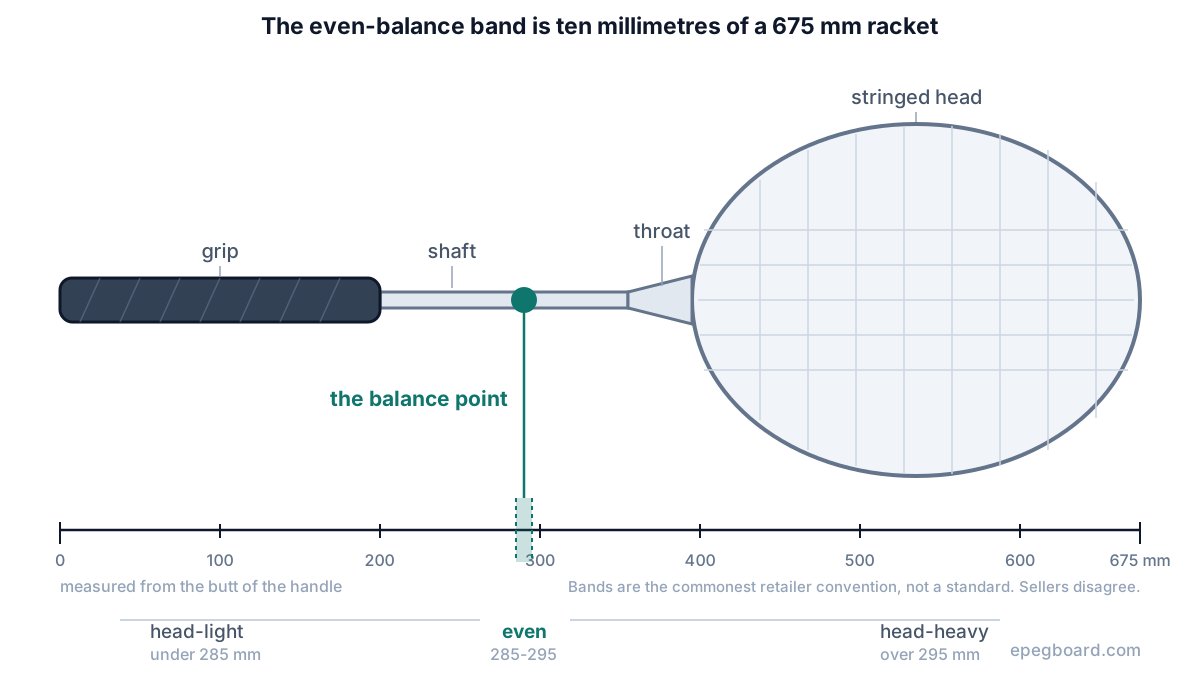
What the balance point on a listing changes is mostly how the racket feels. The consensus across coaching and retailer guidance, which is description rather than measurement, is that head-heavy feels solid and planted and is more tiring over a long evening, while head-light feels quick in the hand and less stable through a clear. Even balance is the sensible default, and it is what Victor's own beginner guidance recommends for a player without a settled style.
Three honest limits on that study. It held mass constant, so it tells you about where the weight sits, not how much there is. Its players were regional to international standard. And what it varied was swingweight - how hard the racket is to accelerate - not the balance point in millimetres a retailer prints. The two are related but not the same, and two rackets balancing at the same point can swing quite differently. It is good evidence that moving mass away from the hand does not buy shuttle speed. It is not a measurement of the rackets you will actually be choosing between.
In short: if you do not have a balance preference yet, start near the middle. Do not buy head-heavy solely because you expect it to manufacture a faster smash.
Shaft flex: stiff or flexible?
If you do not already know your preference, stay away from the extreme stiff end. Manufacturers generally steer developing players towards the middle or more flexible part of their ranges, although their vocabularies do not line up: Yonex rates its beginner frames hi-flex or medium, while Victor recommends 4 to 7 on its one-to-ten handling scale, which is the middle of it, with 8 to 10 stiffer and 1 to 3 more flexible. Victor's scale also rates the whole racket rather than the shaft alone. There is no cross-brand standard, and no way to convert one maker's label into another's.
The reason it matters is that a shaft bends and then straightens during the swing, and that adds racket head speed. A study of eight national and international players found shaft deflection increased head velocity by 13.2% during a full smash, with the effect depending on the relationship between the player, the racket's mass distribution and the shaft. Eight players is a small sample, and we have not found a larger one.
A stiffer shaft demands more consistent timing to exploit, which is why manufacturers steer developing players towards less-stiff frames and stronger players towards stiffer ones. No research has established a swing speed at which one becomes better than the other.
Be clear about what that is and is not. The research explains why flex matters; we found no controlled study establishing an optimal flex for a recreational player. Starting around medium is a conservative buying recommendation built on manufacturer guidance, not a measured physiological optimum.
Does it come strung?
Check whether the racket comes with strings before you compare it on price, because in the catalogue we counted most rackets above about £120 did not, and it is easy to skim past: the listing carries it as "Frame Only" or "String Included" rather than as a number alongside the weight and the balance. Of the rackets whose listing states one way or the other, the share sold frame-only rose steadily with price: 6% below £100, 39% at £100 to £119, 60% at £120 to £139, and all 22 above £180.
This is the one finding here our second catalogue did not reproduce. Central Sports tags supply state on too few listings to test properly, and the handful that do state it do not trend with price at all. So treat the frame-only pattern as what one specialist retailer stocked on one day rather than as a rule of the market - and treat it as a reason to check the listing in front of you, which is the advice either way.
Add a restring and the gap between a frame-only racket and a strung one widens: a £180 frame is not £180. Both retailers we counted discount or include a restring on their dearest frames, so it is worth two minutes before you pay for one separately.
Worked example: what a £180 racket actually costs
£184 for the frame, the cheapest in our count above £180. It arrives unstrung, because up there every racket we counted does. A restring runs about £15 to £30 with the string included, going by the published price lists of eight UK stringers read on 24 August 2026, and more for postal services or premium string. So unless the retailer includes one, call it £205.
You also pick a tension you have no basis for picking, having never hit a shuttle with this frame. The £50 racket next to it arrives strung, playable that evening, and its published specs are the ones that suit you. The difference, £155, is several years of restringing, or a pair of court shoes and change.
In short: find out whether the price includes strings before you compare two rackets on price. Above £180, none of the ones we counted did.
Grip size: does it matter?
Grip size matters less than the amount written about it suggests, and the market has largely decided for you. Of the 228 adult rackets in our count, 185 stated a grip size: 107 were G5, 41 G4, 36 G6, and one an outlier. G5 is the default you will be offered unless you go looking. If you are between sizes the safe move is the smaller one, because adding an overgrip builds a handle up and is the easier direction to travel in.
The evidence here is borrowed. The two studies people cite here are tennis studies, and tennis grips start about an inch larger than badminton ones, so read them as suggestive rather than as findings about your racket.
A 2006 study of sixteen collegiate players found that altering grip size within a quarter of an inch of the recommended fit did not significantly change forearm muscle activity. A 2014 study measured something different - an optimal grip diameter that reduces the grip force a stroke needs, which a biomechanical model suggested lowers the load on the extensor tendons. The two are not in conflict, having measured different things on different strokes, and neither settles it. Nobody should tell you with confidence that your grip size caused your elbow pain.
What should you ignore?
Four things take up most of the space on a racket listing and should change nothing about your decision.
- Isometric heads. A real design, and Yonex claims a larger sweet spot for it than a round frame gives. But the squared-off head is now the norm rather than the exception, so it does not separate the rackets you are choosing between.
- Signature editions. Sometimes just a player's name and a new colourway on a frame that already exists. Badminton HQ says so itself of one Yonex signature series, describing it as carrying "exclusive colourways while maintaining the same performance specifications as the standard models", and the two spec tables we compared match on weight, balance, flex and tension. Not every signature frame is only a colourway, so compare it against the base model before paying the premium. The most expensive racket we counted was one, at £251.95.
- "Match the racket to your playing style." Reasonable advice for somebody who has one. If you are buying a first or second racket you do not yet, and the manufacturers' own answer for that case is even balance.
- Material names. Above about £30 the frame will be graphite with something added, and the something is not comparable between brands. Neither retailer we counted treats material as a spec worth comparing on: one does not tag it at all, the other tags a quarter of its rackets, almost always as the single word "graphite".
One number on the spec sheet is worth respecting: the maximum recommended string tension. Of the rackets in our count that stated a limit, most were rated to 28 lb. Treat it as the manufacturer's stated limit. Stringers will go above it on request, and going above it increases the load on the frame and may affect warranty cover, depending on that manufacturer's terms.
If you are buying strung and have no idea what tension to ask for, you do not need one yet: take whatever the racket ships with, play a term, and change it when you can say what you want to be different. The familiar shorthand is low tension for power and a larger margin on a mis-hit, high tension for control - but treat it as shorthand rather than a law, because how much it constrains you depends on how well you play. A 2013 study tested badminton players at three skill levels across eight string tensions and found that tension limited what novice and recreational players could do, but not the experts, who adjusted their technique and got a good stroke out of any of them. It is one of the few studies here that tested players near your level, and it says the same thing: you cannot judge which side you want before you have hit anything.
Can you try before you buy?
Some UK badminton specialists run demo schemes. We have not compared their terms and will not summarise them here - the ones we looked at differed in every respect that matters, and several we were pointed at turned out to be for tennis or squash. Read the one in front of you and check four things: what it costs up front and how much comes back, how long you get, how many rackets at once, and which brands are excluded.
It is worth doing if you have narrowed it to two rackets, not to discover whether you like badminton rackets. And your club is cheaper: most club nights contain several people who will happily let you hit six shots with theirs.
How much does the racket matter?
The racket matters much less than the amount of advice about it implies. Across 2,386 smashes by 65 international players, where the shuttle struck the strings accounted on its own for about a quarter of the variation in how fast each player's own smashes left the racket. A conference paper on 297 jump smashes by fourteen players at the 2016 All England and 2017 World Championships put impact location and racket head speed together at 89% of it. Where you hit it and how fast you swing matter enormously.
Be precise about what those two show, though. Neither changed the racket. Both modelled how much of the variation in shuttle speed is explained by where and how fast the racket was moving at impact, in players who were already elite - so they cannot weigh technique against specification, or tell you what a different racket would have done. The study that did change the racket is Towler's, above: it moved swingweight across a wide range and shuttle speed did not follow.
And it is worth saying plainly who was tested. The smash-performance studies used regional to international players, and the two grip studies used tennis players - the best evidence we found, but not measured on anyone like you, so read them for the direction of the effect rather than its size. The exceptions are the two that matter most here: the string-tension study tested novices and recreational players, and the racket-weight study tested beginners. Both found less experienced players were affected more - an argument for these specs mattering to you, not less.
What to check on the listing
Four things, in this order. Everything else on the page is describing the racket rather than helping you choose it.
- Weight: start around 4U; consider 5U if you want easier handling. Read the grams because U bands vary slightly by brand.
- Shaft: medium or otherwise away from the extreme stiff end unless you know your preference.
- Balance: around even if you do not yet know whether you prefer head-light or head-heavy.
- Strings: included, not frame-only.
If those four are broadly right and the price is comfortable, you are already close. Do not reject a good racket because a retailer labels the balance a few millimetres either side of "even", or because the shaft says "medium-flex" rather than "medium". These labels are not cross-brand standards.
If you have to compromise, do not treat the filters equally. Balance labels are fuzzy and swingweight is the more meaningful mechanical property, so a slightly head-heavy or head-light listing need not kill the choice. Frame-only is simply a price adjustment. Weight and shaft behaviour are harder to change after purchase.
If you only do one thing
Do not ask which racket is "best". Ask which characteristic you want to change from the racket you already use. If you cannot name one yet, a moderate 4U racket is a far safer experiment than an expensive specialist frame.
Fair games, without the admin
Whatever you are holding, the evening works better when the games are even. ePegboard picks balanced pairings on a club night and keeps the mixing varied, so people play with a range of partners rather than the same three. Free for clubs.
Frequently asked questions
Does any of this apply to a junior racket?
Only loosely. Junior rackets are shorter and lighter than anything in this guide and are sized by the child rather than by playing standard, so the weight advice here does not transfer. The one thing that does carry over is that a lighter frame is easier to swing without a compensating technique.
What about buying second-hand?
The frame is the durable part and a used one is often good value, but you cannot see fatigue in graphite and a hairline crack in the head is invisible until it fails. Budget for a restring on arrival either way, which also gives a stringer a look at the frame.
How often should I restring?
The common rule of thumb is as many times a year as you play in a week, which for most club players means once or twice. Strings lose tension steadily even unused, so a racket that has sat in a bag for two years is not strung to whatever the label said.
Do I need a more expensive racket as I improve?
Possibly, but improvement is what tells you, not the other way round. As your timing and your preferences develop you may find you want a stiffer shaft, a different balance or a particular string setup. Buying those characteristics in advance does not accelerate the development that would justify them.
Is a heavier racket better for doubles?
The usual advice runs the other way, towards a lighter racket for the faster exchanges, and we could not find evidence for either version. What is defensible is that doubles rewards fast hands at the net and quick defensive blocks, which is an argument for a racket that is easy to move rather than one that is hard to.
Should I buy the same racket as my coach or a player I admire?
Only if the specs happen to suit you. A stronger player's racket reflects their own timing, technique and preferences, which may not be yours, and some signature editions are an existing racket in a new colourway, so compare the specs against the base model before paying the premium.
Does the string matter more than the racket?
For how the racket feels, quite possibly, and it is far cheaper to change. If a racket feels dead or boardy, a restring at a different tension is a £20 experiment where a new frame is a £60 one.
Where to go next
If technique is likely to matter more to you than the next equipment upgrade, the next thing worth an evening's attention is where you are standing when the shuttle arrives: badminton doubles positioning covers the two shapes and when to switch between them, and costs nothing.
If you are kitting out a club rather than yourself, how to start a badminton club deals with nets, posts, shuttles and what a hall actually needs.
How this guide was put together
ePegboard builds club-night software. We are not coaches, we do not sell rackets, and we have not tested one. We have no commercial relationship with any racket manufacturer or retailer, including the two whose catalogues we counted, and no link on this page earns us a commission.
The performance claims here come from published research, the legal ones from the Laws of Badminton, and the market ones from our own count. Nothing here is medical advice.
The count: on 23 August 2026 we read the public product feeds of Badminton HQ and Central Sports. Badminton HQ's catalogue gave 228 adult single rackets after excluding 9 junior rackets and 6 multi-racket sets and training aids, and every market-structure figure quoted above is from that catalogue alone; Central Sports' 186 rackets were used only to check that the trends ran the same way. They do for balance and shaft, both of which climb with price in both catalogues. They could not be checked for whether a racket comes strung: Central Sports' figures for that run 50%, 8%, 59%, 31%, 60% and 94% across the bands, which is irregular rather than the clean monotonic pattern Badminton HQ shows. With so few of its listings tagged either way, we do not regard it as a successful replication.
Prices are the lowest listed variant on the day, sale prices included, so they read low against list. Specifications are the retailers' own product tags, which describe how a racket is marketed rather than measurements we took. It is a one-day snapshot and we did not weigh, string or hit anything. Both feeds are public and the counts are reproducible; we will share the analysis scripts with anyone who asks.
Sources: BWF Laws of Badminton, Law 4 (Section 4.1, V5.0, in force 26 April 2025) · Towler, Mitchell & King (2023) on swingweight and shuttle speed · McErlain-Naylor et al. (2020) on impact location · King, Afzal & McErlain-Naylor (2019) on impact location and head speed · Phomsoupha, Ibrahime & Laffaye (2024) on shaft deflection · Zhu (2013) on string tension and skill level · Pan et al. (2024) on 3U vs 5U adaptation in advanced and beginner players · Hatch et al. (2006) on tennis grip size and forearm muscle firing patterns · Rossi et al. (2014) on tennis grip size and lateral epicondylalgia risk · Victor on choosing a beginner racket · YC Sports on the 285/295 mm balance convention · Li-Ning's own racket weight guide · Badminton Bay's weight chart, for the W bands
Published 24 August 2026 by ePegboard.