

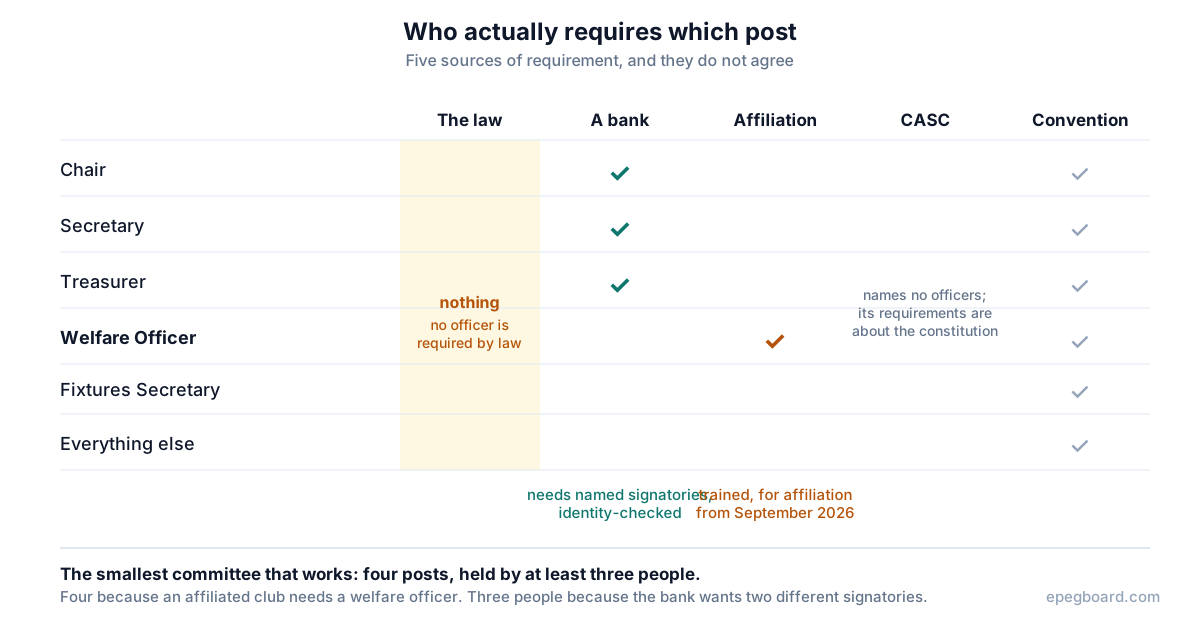
The law requires none of them, and almost everything you think is required comes from somewhere else. The bank is what actually forces a chair, a secretary and a treasurer, because it wants a constitution, minutes appointing signatories, and identity checks on each of them. And every affiliated club now also needs a Club Welfare Officer, trained in preparation for affiliation from September 2026, whether or not it has any juniors.
The version that catches clubs out is the AGM where three people are willing, four posts are apparently compulsory, and nobody in the room can say which of them actually is.
The short version
- No officer is required by law. An unincorporated association has no post it must fill, nothing to register and nothing to file.
- The bank is what forces the classic three. It wants signatories, and it wants them named in minutes and identity-checked.
- An affiliated club now needs four, not three. A Club Welfare Officer, trained in preparation for affiliation from September 2026, regardless of juniors. The DBS that goes with the post is conditional on having under-18s; the training is not.
- Being on the committee does not need a DBS check. Badminton England's own training matrix says so in one word: N/A.
- Four posts can be held by three people. Real badminton constitutions permit doubling up; the bank just needs two different signatories.
- Not filling a post spreads liability rather than removing it. Where there are no officers, exposure sits with the committee, and failing that, the members.
Written for a UK club officer working out which posts must be filled. Badminton England's requirements were read from their own pages on 26 August 2026; the club examples come from nine published badminton club constitutions read the same day, a convenience sample rather than a representative one. Not legal advice.
In this guide
Which roles does the law require? So why does everyone say chair, secretary and treasurer? Do we need a Club Welfare Officer if we have no juniors? What is the smallest committee that works? Can one person hold two posts? Does a committee member need a DBS check? What does each role actually involve? What are you personally on the hook for? What if we cannot fill a post? Frequently asked questionsWhich roles does the law require?
None of them. A badminton club that is an unincorporated association has no officer it is legally required to appoint.
There is no register to join, nothing to file, no audit requirement, and no statutory list of posts. Guidance for clubs on constitutions puts it about as plainly as it can be put: there are no specific rules on the form or content of an unincorporated association's constitution, as long as what is in it is not illegal.
That is worth sitting with for a moment, because it means every requirement you have ever been told about came from an organisation rather than from the law. Once you know which organisation, you know whether it applies to you.
So why does everyone say chair, secretary and treasurer?
Because of the bank, more than anything else.
Opening an account for a club means producing a constitution, minutes of the meeting that appointed the signatories, and identity and address documents for each of those signatories, who are also credit-checked. Banks typically want a minimum of two signatories, and commonly recommend naming three with any two authorised to sign.
That is the real origin of the classic three. Once you need three named people who can be identified, credit-checked and held to account, you have effectively created a chair, a secretary and a treasurer, whatever you call them.
All nine of the published badminton constitutions we read name those three, or a President in place of the chair. The convention is real. It is just not law, and knowing the difference matters when somebody tells you the club is not allowed to operate without a vice-chair.
Do we need a Club Welfare Officer if we have no juniors?
If your club is affiliated to Badminton England, yes - and this changed recently enough that a lot of clubs have not caught up.
The older position had three triggers: junior clubs, clubs with junior members, and clubs competing in leagues. That third trigger already caught plenty of adults-only clubs and surprised them. The current position is simpler and broader. Under a programme Badminton England calls A Sport That Cares, every affiliated club and group must appoint a Club Welfare Officer, and that person must be "trained in preparation for affiliation from September 2026".
Note what is and is not conditional there. The training is required of every affiliated club. The DBS check attached to the post is required only of clubs with any under-18s. Those are two different tests and clubs routinely merge them, usually concluding that an adults-only club is exempt from both. It is exempt from one.
And the welfare officer is not the whole of it. The same phase asks affiliated clubs for two more things that are easy to miss because the welfare officer gets all the attention: every coach must be registered with Badminton England as a Coach Member with an active licence, and every role must hold the training its row of the Badminton England Training Matrix requires. If you are working through this, work through all three.
Badminton England's own guidance now names four posts rather than three. Their club committee page says that in general all clubs share four common roles, and lists chair, secretary, treasurer and welfare officer, with a downloadable role description for each.
How many clubs have done it is not published, and be wary of any figure that says otherwise. The one published number we could find is not a compliance rate: Badminton England's annual report to 31 March 2025 lists 99 Welfare Officer memberships. That category had only just been created, so 99 is a new thing's early uptake rather than a count of clubs that have complied, and it should not be read as either.
Our own reading of nine published club constitutions is the only other evidence we have, and it is a convenience sample rather than a measurement: six name a welfare officer, two do not mention one at all, and two make it conditional or optional. One of those was adopted in June 2025 and lists the post as optional, which was defensible when it was written and is not now.
What is the smallest committee that works?
Four posts, held by at least three people.
Four because that is what an affiliated club now needs: chair, secretary, treasurer, welfare officer. Three people because the bank will want two different individuals as signatories, so you cannot run the whole thing on one person however willing they are.
That is a slightly awkward answer and it is the honest one. Most guidance says three posts. Most guidance was written before the welfare officer became universal.
Can one person hold two posts?
Yes, and real badminton constitutions say so explicitly.
One club we read allows an officer to hold one other post. Another allows officers to hold more than one, up to a maximum of three. Neither is unusual and neither is a compromise: a small club covering four posts with three people is operating normally, not cutting corners.
The one constraint is the bank. You need at least two distinct people able to sign, so the treasurer cannot also be the only other signatory. Beyond that, pair the posts that share information rather than the ones that share a person's free evening: secretary and welfare officer sit together reasonably well, because both are about members and communication.
Does a committee member need a DBS check?
No. Being on the committee is not, by itself, a role that requires or even permits a criminal records check.
Badminton England's own club training matrix answers this in a single word. Against "club committee roles", under the DBS column, it says: N/A. What committee members are asked to do instead is read an introduction to safeguarding, with the online safeguarding training recommended rather than mandatory.
This matters more than it sounds, because eligibility for a check is set by legislation rather than by preference, and submitting an application for somebody who is not eligible is not a harmless excess of caution. It processes a volunteer's criminal record history without a lawful basis for doing so.
The welfare officer is the exception, and even there it is conditional. The same matrix requires the Club Welfare Officer to hold an enhanced DBS where the club has any under-18 players, and requires them to complete Badminton England's welfare officer workshop with refresher education every two years. Note that the training requirement is universal for affiliated clubs while the check is conditional on juniors. Those are two different tests and clubs merge them constantly.
What does each role actually involve?
Less than the role descriptions suggest for most posts, and more than people expect for the welfare officer.
| Post | The actual job | Required by |
|---|---|---|
| Chair | Runs the meetings, holds the casting vote, is the person the venue and the league contact | Bank, convention |
| Secretary | Correspondence, minutes, membership records, affiliation paperwork | Bank, convention |
| Treasurer | Collects subs, pays the hall, produces annual accounts | Bank, convention |
| Welfare Officer | Point of contact for welfare concerns, reports to the governing body, keeps safeguarding on every meeting agenda, checks coaches hold a current licence | Affiliation |
| Fixtures or Match Secretary | Arranges league fixtures and teams | Nobody, but badminton clubs need it |
| Everything else | Social, membership, communications, captains | Nobody |
The fixtures secretary is worth a note. It appears in published badminton constitutions more often than any generic cross-sport guidance mentions it, because arranging league matches is a real recurring job that most sports do not have in the same form. If your club plays in a league, that post exists whether or not you have named it.
The welfare officer's role description is the longest of the four and the least like what people expect. Badminton England lists nine duties, and the tone is notable: they describe the ideal candidate as the club's people person rather than as an administrator, and state there is no expectation of previous safeguarding knowledge, because the workshop supplies it.
What are you personally on the hook for?
More than most officers realise, and the exposure comes from the club's legal form rather than from the post you hold.
An unincorporated association is not a separate legal person. Its members are personally responsible for its obligations, and club constitutions say so: one badminton template states plainly that all members are jointly and severally responsible for the club's financial liabilities.
Where debts to public bodies are concerned, the exposure follows a hierarchy: first anyone holding office as president, chairman, treasurer, secretary or similar; if there is nobody in those posts, every committee member; and if there is no committee, every member.
Read that hierarchy carefully, because it inverts the instinct. Leaving the treasurer's post vacant does not protect anybody. It moves the exposure outwards, from one named person to the whole committee, and then to the whole membership.
What covers this is a separate question with a separate answer, and it is worth knowing that club affiliation insurance covers administrators and committee rather than players. If your committee has never checked what its own cover actually says, that is a more urgent job than filling a vacant social secretary post.
What if we cannot fill a post?
It depends entirely which post, and for most of them the honest answer is that nothing happens.
Nobody enforces a vacant social secretary. Nobody checks whether you have a vice-chair. The posts beyond the core four exist because a club found them useful, and a club that does not need them is not failing.
The four that are different, and why: without a treasurer and a second signatory your bank account becomes unusable, which stops the club rather than inconveniencing it. Without a welfare officer your affiliation is non-compliant, which puts the insurance that covers your committee in question. Those are the ones worth going round the room twice for.
And the concession this guide owes you: if you have four willing people, a bank account that works and a welfare officer who has done the workshop, you are compliant and you can stop reading committee-structure advice. The nine-role committees you will see published elsewhere are what large clubs grew into, not a standard you are failing to meet.
If you only do one thing
Check whether your club has a Club Welfare Officer who has completed the workshop. If it has not, that is your affiliation from September 2026. The workshops are free, run online, and Badminton England has dates through September and October.
Fair games, without the admin
ePegboard has no view on your committee structure. What it removes is one of the recurring jobs a committee usually has to give somebody: running the night itself, picking balanced games and keeping court time even, so that post never has to exist. Free for clubs.
Frequently asked questions
What is the difference between a President and a Chair?
Usually that the President is honorary and the Chair does the work, though clubs use the words interchangeably and some have both. One club in our survey has a President and no Chair at all. Whatever you call it, the bank and your affiliation care about who signs and who is accountable, not about the title.
How long should someone serve in a post?
Your constitution may already say, and if it does not, that is worth adding. Fixed terms with re-election make it easier for somebody to stand down without it feeling like a resignation, which is usually the real obstacle rather than any shortage of willing people.
Do committee members have to be club members?
In nearly every club constitution we read, yes, and it is worth keeping that way. A committee member who is not a member has an unclear relationship to the club's rules and to its insurance.
Can we have a committee without a formal constitution?
You can run a club that way and many do, but you will hit a wall the first time a bank, a funder or a landlord asks. The committee and the constitution tend to arrive together for that reason.
Should the coach be on the committee?
It happens and it is not a problem in itself. Where it gets awkward is if the coach is paid, because they are then sitting on the body that decides their own fee. Some clubs handle it by having the coach attend without a vote.
Where to go next
The document that names these posts and defines their powers is the constitution, and most clubs' are older than they think: writing a badminton club constitution covers which template to start from and which clauses in it are wrong.
The treasurer's actual job is the two articles next door: setting club subs covers what to charge, and collecting club subs covers getting paid without losing your evenings.
And if you are assembling a committee because you are starting from scratch, how to start a badminton club covers the rest of it.
How this guide was put together
ePegboard builds club-night software. We are not lawyers and we have never sat on a badminton club committee. Badminton England's requirements here were read from their own pages on 26 August 2026, including their club committee guidance, the Club Welfare Officer role description and the club training matrix. The club examples come from nine published badminton club constitutions read the same day.
Three limits worth stating. Nine constitutions found through search is a convenience sample, not a picture of the sector. Nobody publishes how many affiliated clubs have appointed a trained welfare officer, so we have given no compliance figure and would treat any you are shown with suspicion. And the liability hierarchy described above comes from tax regulations covering specific levies; the principle is sound and its precise reach across all club debts is not something we could establish.
Sources: Badminton England on effective club committees · Badminton England, A Sport That Cares (the minimum standards) · Badminton England Annual Report 2025 (PDF) · Badminton England club training matrix · Badminton England on club welfare officers · HMRC, Community Amateur Sports Clubs guidance · The Resource Centre on bank accounts for community organisations
Published 26 August 2026 by ePegboard. Badminton England pages and their Annual Report 2025 read 26 August 2026.